The upside of global tech fragmentation for lithium producers
Why the global technology disorder is arguably an opportunity — and what a single country can realistically do about it.
GEOCONOMICS AND LITHIUM SUPPLY CHAINSAI, SPACE, TECHNOLOGY
George Katito, PhD
4/19/202612 min read
In Brief
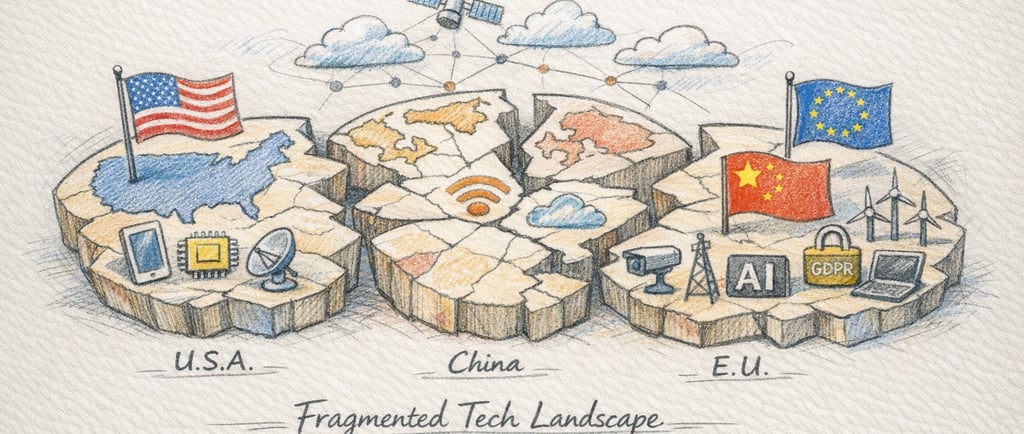
The global technology order is fracturing along a fault line that runs directly through the battery supply chain. The US and China are assembling incompatible ecosystems — different chips, different AI standards, different data regimes. Countries that have already committed their infrastructure to one side inherit all its constraints. Those that have not yet committed hold a rare, time-limited strategic opportunity.
The Biden-era IRA — which gave US critical minerals policy its coherence as a demand-side pull for EV supply chains — has been substantially dismantled. EV tax credits expired in September 2025. The US has not abandoned critical minerals strategy, but it has changed instruments toward bilateral deals that have replaced multilateral clean energy architecture. Lithium producing states have an opportunity to engage this volatility with clear eyes and short commitment horizons.
The EU Battery Passport framework, which enters force progressively from 2027 and is set in statute rather than at any administration’s discretion, is now the more durable Western anchor for supply chain compliance strategy. Building the national institutional infrastructure to satisfy it — sovereign data systems, credible certification, primary geological data held nationally — is the country-level priority that serves all major counterparties (US, China, EU) simultaneously.
Producer coordination — a lithium OPEC — is a recurring idea with a well-developed academic literature and a poor empirical track record. The structural obstacles are real and not going away. Critical minerals attract resource nationalism, not solidarity. A small state navigating fragmentation is better served by maximising its individual leverage at the concession table than by waiting for collective bargaining that may be slow to materialise and function effectively.
The Shifting Geoeconomics of the Technology Landscape
Geoeconomics is not a recent invention. What is new is the speed and scale at which the major economies now deploy economic instruments as instruments of geopolitical competition, and the degree to which the battlefield has migrated from trade and finance to technology infrastructure.
Three moves initially defined the new global tech landscape: the US CHIPS and Science Act (2022), allocating USD 52 billion to rebuild domestic semiconductor manufacturing after the strategic shock of discovering that most advanced chips come from one island whose sovereignty is disputed; the EU Critical Raw Materials Act (2024), imposing supply chain diversification targets for 34 strategic minerals including lithium; and China’s export restrictions on gallium, germanium, and graphite from 2023 — raw materials necessary for American chip fabrication (Mohr and Trebesch, 2025).
Subsequently, a fourth move has been added to the landscape of the geoeconomics of technology : the systematic dismantling, by the Trump administration, of the demand-side architecture that gave US critical minerals strategy its economic coherence.
The Inflation Reduction Act (IRA)’s battery supply chain logic worked through demand creation. By subsidising EV purchases and attaching mineral sourcing conditions to those subsidies, it gave Washington a mechanism for directing supply chain investment toward preferred partners. The One Big Beautiful Bill Act (OBBBA), signed on 4 July 2025, on the other hand, terminated the clean vehicle credits effective 30 September 2025 and accelerated the wind-down of most remaining clean energy manufacturing incentives (Arnold & Porter, 2025).
The CHIPS Act (CHIPS standing for “Creating Helpful Incentive to Produce Semiconductors” for America Act) underwent a parallel, if less complete, transformation. The administration restructured it under a new ‘Investment Accelerator’ office with an explicit mandate to renegotiate Biden-era agreements on more favourable terms (Executive Order, March 2025). A 25 percent levy on certain advanced computing chips followed in January 2026. The broader posture is not hard to read: the Trump administration is comfortable with semiconductor industrial policy in principle, but insists on running it bilaterally, transactionally, and with tariffs as the enforcement mechanism rather than subsidy conditions.
For a small lithium producer state, the relevant question is: what does this competition among the leading tech economies create for states that have not yet committed? The answer is that fragmentation generates more strategic space for uncommitted states than a stable, US-dominated order would.
But the nature of the fragmentation has changed. It now includes a major Western actor whose strategic commitments are subject to revision by executive order, whose industrial policy can be terminated by a budget reconciliation bill, and whose engagement with mineral producers is transactional in a way that differs structurally from the rule-based EU framework.
The New US Posture and the Art of the Bilateral Deal
The Trump administration’s critical minerals strategy has changed shape. What the Biden administration pursued through the IRA’s multilateral architecture, the Trump administration is pursuing through direct bilateral dealmaking, the US International Development Finance Corporation (DFC) equity stakes, and infrastructure investment. By early 2026, the administration had signed critical minerals agreements with Ukraine, Saudi Arabia, Thailand, Malaysia, Japan, and the DRC. It continued and expanded the Lobito Corridor investment, with the DFC committing USD 553 million to refurbish the railway connecting the DRC and Zambia to the Angolan coast (Foreign Policy, 2026). A ‘Pax Silica’ initiative, announced in December 2025, framed this as an effort to build US-aligned supply chains around compute, silica, and minerals as shared strategic assets.
The US National Security Strategy (November 2025) made the underlying logic explicit: critical mineral supply chain security is a matter of national security, with the focus weighted toward defence stockpiles rather than clean energy transition. The One Big Beautiful BIll Act (OBBBA) allocated USD 7.5 billion for critical minerals, of which USD 2 billion went to the national defence stockpile and USD 5 billion to the Department of Defense for supply chain investment (Canary Media, 2025). This creates a government procurement pull rather than a consumer demand pull — more susceptible to shifts in defence priorities that lithium producer states cannot anticipate in advance.
The DRC’s recent experience is instructive. Kinshasa secured a strategic partnership agreement with Washington in December 2025, partly by offering critical mineral access in exchange for US support in its conflict with M23 rebels. This poignantly captured the nature of transactional diplomacy that functions on a quid pro quo basis.
Why Not Having Chosen Yet Is an Asset: Zimbabwe as a case in point?
By early 2026, Zimbabwe’s two largest lithium mines are embedded in Chinese industrial supply chains. Sinomine’s acquisition of Bikita and Huayou Cobalt’s acquisition of Arcadia represent combined capital commitments well above USD 500 million. Zimbabwe is, in this sense, already partly committed to one side of the technology competition.
But only partly. The EU’s Battery Regulation (Regulation (EU) 2023/1542) — whose Battery Passport requirements enter force progressively from 2027 — creates a structurally parallel demand. Battery manufacturers selling into the EU must demonstrate, with auditable data, where their lithium came from, how it was extracted, and how it was processed. That documentation cannot be produced retroactively from a foreign data centre. It requires functioning national institutions in the country of origin: a geological survey holding primary data, certification systems with legal standing, and a chain of custody beginning at the drill site and ending at the battery cell. European manufacturers need these institutions to exist in Zimbabwe.
The EU Battery Passport framework has not been dismantled, renegotiated, or subjected to executive revision. It is set in regulation. It applies to any battery sold into the EU market regardless of electoral processes in member sates. This is, under present conditions, its most important feature.
Lithium producing states are thus in precisely the structural position that Farrell and Newman’s (2019) framework identifies as potentially powerful: states sitting at the intersection of two or more competing networks whose resources they all need, and whose institutional choices determine which network captures the certification value. It is, in short, a good problem to have — provided one treats it as a problem to be solved.
The Mathematics of Fragmentation
Global lithium demand reached approximately 180,000 tonnes of lithium carbonate equivalent (LCE) in 2023. The IEA projects demand reaching between 500,000 and 900,000 tonnes LCE by 2030, depending on the pace of EV adoption (IEA, 2024).
That projection predates the OBBBA’s termination of US EV tax credits; the lower end of the range is now more plausible for the US market specifically. Globally, the picture is different.
Outside the United States, EV adoption continues to accelerate. BMW saw fully electric vehicle sales surge in early 2025; Volkswagen reported a 64 percent order intake increase for battery electric vehicles in Europe in the same period. China’s battery industry, which produced approximately 77 percent of the world’s lithium-ion battery cells in 2023 (IEA, 2024), is not slowing because Washington changed its mind about tax credits. The demand story for lithium has not collapsed but has reweighted toward European and Chinese demand, and away from a US market whose domestic EV trajectory is now genuinely uncertain.
A challenge for lithium producing states in this context is that of building institutional infrastructure and data systems to certify ore’s provenance. That infrastructure serves all three counterparties (US, China, and the US) simultaneously. Such infrastructure's value is not contingent on who wins the next elections in the major economies.
Blackwill and Harris (2016) observe that states which delay these choices do not avoid them. They make them by default, at terms they did not negotiate. Under present conditions, ‘by default’ means accepting whichever bilateral deal arrives first with a cheque attached.
What Lithium Produces Can Actually Do: The Case of Zimbabwe
A note on scope: The reflections that follows are deliberately country-level. The idea of producer coordination — a lithium OPEC, a regional minerals pact — recurs in the academic literature and in policy circles, and the structural argument is compelling. But the empirical track record is poor.
Critical minerals attract resource nationalism rather than solidarity; the asymmetries between producer states in fiscal position, investment exposure, and political relationship with major buyers are wide enough to make coordination discipline implausible; and the geological heterogeneity of lithium deposits — hard-rock spodumene in Zimbabwe is a technically different product from brine-derived lithium carbonate in Chile — means that standardised cartel behaviour across producers is considerably harder than the OPEC analogy suggests (Nachmany and Davidescu, 2022).
The realistic unit of action is the state. The realistic question is what a single, under-resourced government can do to navigate fragmentation intelligently, given that it will almost certainly be negotiating alone.
Concession Conditions as the Primary Instrument
Zimbabwe’s most immediate leverage requires using the tools already available at the concession renewal moment — which is approaching for both Bikita and Arcadia within the next several years. Concession renewal is the single point in the mining relationship at which the host government holds maximum leverage, because the operator’s capital is already sunk, its processing relationships are in place, and the cost of losing the licence is asymmetric. A well-prepared government enters that moment with a specific set of draft conditions--- where an unprepared government receives the operator’s preferred terms, which will not have been drafted with the host country’s interests as the primary consideration.
Four conditions, attached to concession renewals, together build the infrastructure this argument requires. First, mandatory deposition of primary geological data with the Zimbabwe Geological Survey — not copies held abroad, but the primary dataset held nationally, with access governed by Zimbabwean law.
Second, on-site initial processing requirements, which capture a share of value-add before the ore leaves the country and simultaneously generate the processing data that EU Battery Passport compliance requires.
Third, a geological data levy — a fee charged to operators for access to national survey data used in their AI-driven exploration and resource modelling systems — which converts the country’s geological endowment from a free public good into a priced national asset.
Fourth, model licensing reciprocity: any AI exploration model trained on Zimbabwean geological data must license that model back to the Zimbabwe Geological Survey, building national technical capacity rather than simply exporting it.
These conditions are not novel in principle. They are standard elements of resource sovereignty doctrine applied specifically to the data and AI layer of modern mining operations, where most of the analytical value — and most of the informational asymmetry between operator and host government — currently sits.
Their enforceability depends on the legal classification of geological data as a national strategic asset, which is a statutory step that several resource-producing states have already taken in analogous contexts.
On the EU Battery Passport
The capital required for a functional Zimbabwe Geological Survey data management facility — servers, digitisation programme, bandwidth, and 15 to 20 specialist staff — sits in the range of USD 8 to 12 million. This is not a large number relative to the investment already in the ground. The EU Battery Passport compliance requirement creates the revenue stream that justifies it: a credibly sovereign certification system, operated by a Zimbabwean institution and recognised under EU regulation, is a product that European battery manufacturers will pay for, because without it they cannot sell into the EU market.
The IFC’s USD 90 million equity investment in Cassava Technologies — Zimbabwe-based Africa Data Centres — alongside Google and Finnfund in December 2024 demonstrates that development finance appetite for Zimbabwean digital infrastructure is not theoretical (IFC, 2024).
Chinese Digital Silk Road finance remains a further channel for the physical infrastructure. The institutional safeguard against vendor lock-in is the legal framework: once geological data is classified as a national strategic asset and localisation is mandated by statute, what any infrastructure partner can access is constrained by law rather than by goodwill. One can accept the loan and keep the data.
US DFC financing is a fourth channel, and under the current administration’s bilateral minerals strategy, a live one. A Zimbabwean government that has already established its data governance framework and is building EU-compliant certification infrastructure is a more credible DFC partner than one that has not — because it can offer Washington supply chain visibility and provenance verification from an institution with genuine legal standing in the country of origin.
The EU and US frameworks are not identical, but they are compatible on the fundamental question of data sovereignty. Building to the more demanding standard — EU — satisfies the less demanding one for free.
Navigating the Nationalist Lens
A candid observation is necessary here: The strategy described above requires a state capable of enforcing concession conditions against well-capitalised operators, classifying data as a strategic asset and making that classification stick, and building technical institutions that outlast individual administrations. However, a nationalist impulse — to extract maximum rent immediately, to impose conditions that operators cannot comply with, or to use mineral policy as a signal of political strength rather than a tool of economic strategy — is a real and recurring risk. So is the opposite: a technocratic eagerness to offer favourable terms in exchange for investment that arrives with strings the host government did not fully read.
The tech landscape fragmentation dividend is not available to governments that approach it purely through a nationalist lens, because nationalism optimises for the wrong variable: It maximises the visible assertion of sovereignty at the expense of the durable institutional capacity that makes sovereignty economically meaningful.
A government that announces sweeping processing requirements without building the certification infrastructure that gives those requirements international commercial standing has performed resource nationalism without capturing its benefits.
The conditions this article recommends are not nationalist in that sense. They are technocratic — specific, enforceable, commercially grounded, and designed to accumulate institutional capacity rather than to signal defiance.
Closing Arguments: The Geoeconomic Case
The geoeconomic case is not complicated, though the execution requires sustained political will and a degree of institutional competence that should not be assumed. Lithium producers tend to sit at the intersection of competing technology ecosystems, all of which need it and none of which can substitute for it on any credible timeline.
The legal instruments to protect the informational dimension of that position are available, precedented, and modest in cost relative to the investments already in the ground.
What has changed is the context. The Biden administration’s IRA provided a stable, rule-based Western anchor for supply chain alignment. That anchor is gone. What the Trump administration offers in its place — bilateral deals, DFC equity stakes, rhetorical enthusiasm for African commercial partnership — is not without value, but it operates on a shorter time horizon, with weaker guarantees, and it has already demonstrated in one legislative cycle that its commitments are subject to revision.
The EU Battery Passport, written into statute and indifferent to the composition of the US administration, is arguably the more durable anchor.
The case for producer coordination is noted, taken seriously in the academic literature, and set aside. The realistic unit of action is the state. The realistic question is what small lithium producing states like Zimbabwe can do, alone, at the concession table, with the legal instruments available to it — before the window that fragmentation has opened becomes, through inaction, commitment by default.
REFERENCES
Arnold & Porter (2025) From IRA to OBBBA: A New Era for Clean Energy Tax Credits. Advisory, July 2025. Available at: https://www.arnoldporter.com/en/perspectives/advisories/2025/07/from-ira-to-obbba-a-new-era-for-clean-energy-tax-credits (Accessed: 10 April 2026).
Blackwill, R.D. and Harris, J.M. (2016) War by Other Means: Geoeconomics and Statecraft. Cambridge, MA: Harvard University Press. ISBN: 9780674737044.
Canary Media (2025) The year the US doubled down on critical minerals. 26 December 2025. Available at: https://www.canarymedia.com/articles/clean-energy-supply-chain/us-critical-minerals-2025-trump (Accessed: 10 April 2026).
CSIS (2026) New Executive Order Ties U.S. Critical Minerals Security to Global Partnerships. Center for Strategic and International Studies, January 2026. Available at: https://www.csis.org/analysis/new-executive-order-ties-us-critical-minerals-security-global-partnerships (Accessed: 10 April 2026).
European Parliament and Council (2023) Regulation (EU) 2023/1542 concerning batteries and waste batteries. Official Journal of the European Union, L 191, 28 July 2023. Available at: https://eur-lex.europa.eu/legal-content/EN/TXT/?uri=CELEX:32023R1542 (Accessed: 21 March 2026).
Executive Office of the President (2025) Establishing the United States Investment Accelerator. Executive Order, 31 March 2025. Washington, DC.
Farrell, H. and Newman, A.L. (2019) ‘Weaponized Interdependence: How Global Economic Networks Shape State Coercion’, International Security, 44(1), pp. 42–79. DOI: 10.1162/isec_a_00351.
Foreign Policy (2026) Trump AI Mineral Hunt Goes Global. 21 January 2026. Available at: https://foreignpolicy.com/2025/12/18/trump-ai-critical-minerals-supply-chain-tech-pax-silica/ (Accessed: 10 April 2026).
IEA (2024) Global Critical Minerals Outlook 2024. Paris: International Energy Agency. Available at: https://www.iea.org/reports/global-critical-minerals-outlook-2024 (Accessed: 21 March 2026).
IFC (2024) IFC, Google and Finnfund Invest in Africa Data Centres. Press release, December 2024. Washington, DC: International Finance Corporation. Available at: https://pressroom.ifc.org/all/pages/PressDetail.aspx?ID=27819 (Accessed: 21 March 2026).
Mohr, C. and Trebesch, C. (2025) ‘Geoeconomics’, Annual Review of Economics, 17, pp. 563–587. DOI: 10.1146/annurev-economics-092424-111952.
Nachmany, M. and Davidescu, S. (2022) ‘Understanding Cartel Viability: Implications for a Latin American Lithium Suppliers Agreement’, Energies, 15(15), p. 5569. DOI: 10.3390/en15155569.
US Congress (2022) CHIPS and Science Act of 2022, Pub. L. 117-167, 136 Stat; 1366. Washington, DC.
US Congress (2025) One Big Beautiful Bill Act, H.R. 1, 119th Congress. Signed 4 July 2025. Washington, DC.
Wilson Center (2026) Critical Minerals Strategy under the Trump Administration: Progress, Contradictions, and the Road Ahead, 7 April 2026. Available at: https://www.wilsoncenter.org/article/critical-minerals-strategy-under-trump-administration-progress-contradictions-and-road (Accessed: 10 April 2026).