The Greening of Weaponry?: Militaries, Electrification, and Climate Crises
3/5: Third in a five-part series on lithium, rearmament, and the securitisation of the lithium supply chain.
LITHIUM AND MILITARY APPLICATIONS
George Katito, PhD
7/16/20265 min read
In brief
The climate rationale for military electrification has been formally abandoned in Washington and quietly narrowed in NATO: the US Secretary of War has publicly repudiated climate objectives, and alliance sustainability work now targets efficiency and resilience rather than emissions reduction. Militaries generate an estimated 5.5 per cent of global emissions (Conflict and Environment Observatory), and NATO's post-2022 spending surge alone adds an estimated 98–218 million tonnes of CO₂-equivalent a year.
Electrification is accelerating anyway, because batteries buy tactical qualities: silence, suppressed heat signatures, longer drone flight times, burst power for laser weapons, and shorter fuel-supply lines — fewer of the tanker convoys that cost lives on the roads of Afghanistan.
A reasoned central estimate puts military battery demand growth at 8–12 per cent compounded annually to 2035 — above the 4–5 per cent growth implied by the equipment programmes militaries were already running, below the 12.5 per cent projected by battery suppliers themselves — driven by drone programmes and vehicle hybridisation. Even at 12 per cent growth, military use would still claim under 3 per cent of global lithium demand in 2035.
A natural question for anyone modelling lithium demand is whether militaries will "green" their technology — electrify to cut emissions — and thereby add a new load to the supply chain. The record as of mid-2026 gives a two-part answer: the greening motive has collapsed, and the electrification it once sponsored is accelerating regardless.
The rise and retreat of green defence
The climate agenda in defence peaked early this decade. At the COP26 climate conference in 2021, NATO Secretary General Jens Stoltenberg pledged a methodology for counting military emissions and a feasibility study on reaching net zero by 2050, conceding that "there is no way to reach net zero without also including emissions from the military." Even then, every alliance communiqué carried the decisive caveat: emissions reductions must never impair "personnel safety, operational effectiveness and our deterrence and defence posture."
The scale of the exemption is considerable. The Conflict and Environment Observatory and Scientists for Global Responsibility estimate that routine military activity generates around 5.5 per cent of global greenhouse-gas emissions — if the world's militaries were a country, they would rank as the fourth-largest emitter — yet the Paris Agreement imposes no reporting requirement on military fuel use. The same researchers calculate that NATO's post-2022 spending increases alone add between 98 and 218 million tonnes of CO₂-equivalent per year.
By 2025 the political direction had reversed outright. US Secretary of War Pete Hegseth declared that his department "does not do climate change crap" and would not be "distracted" by what he termed "woke moralizing." European defence analysis has adjusted accordingly: recent NATO-adjacent assessments of "green defence" concede that alliance sustainability work now aims at resilience and efficiency, because energy-dense hydrocarbon fuels remain irreplaceable for combat aircraft, warships and armoured formations, and no defence planner will trade readiness for emissions targets.
Electrification without the climate motive
Procurement records tell a different story from the rhetoric, because batteries purchase qualities that have nothing to do with emissions.
Batteries buy silence and a suppressed heat signature: a hybrid armoured vehicle on "silent watch" runs its sensors, jammers and command systems with the engine off, invisible to thermal imaging.
They buy endurance for drones, where every gram of stored energy converts into range — the distance an aircraft covers on one charge — and loiter time: the hours a drone can stay airborne over its target area, circling and observing, before the battery runs down. A surveillance drone with twice the loiter time watches the same stretch of road for twice as long before a replacement must launch, which is why Sion Power now supplies lithium-metal cells (a next-generation chemistry storing more energy per gram than conventional lithium-ion) to defence drone manufacturers.
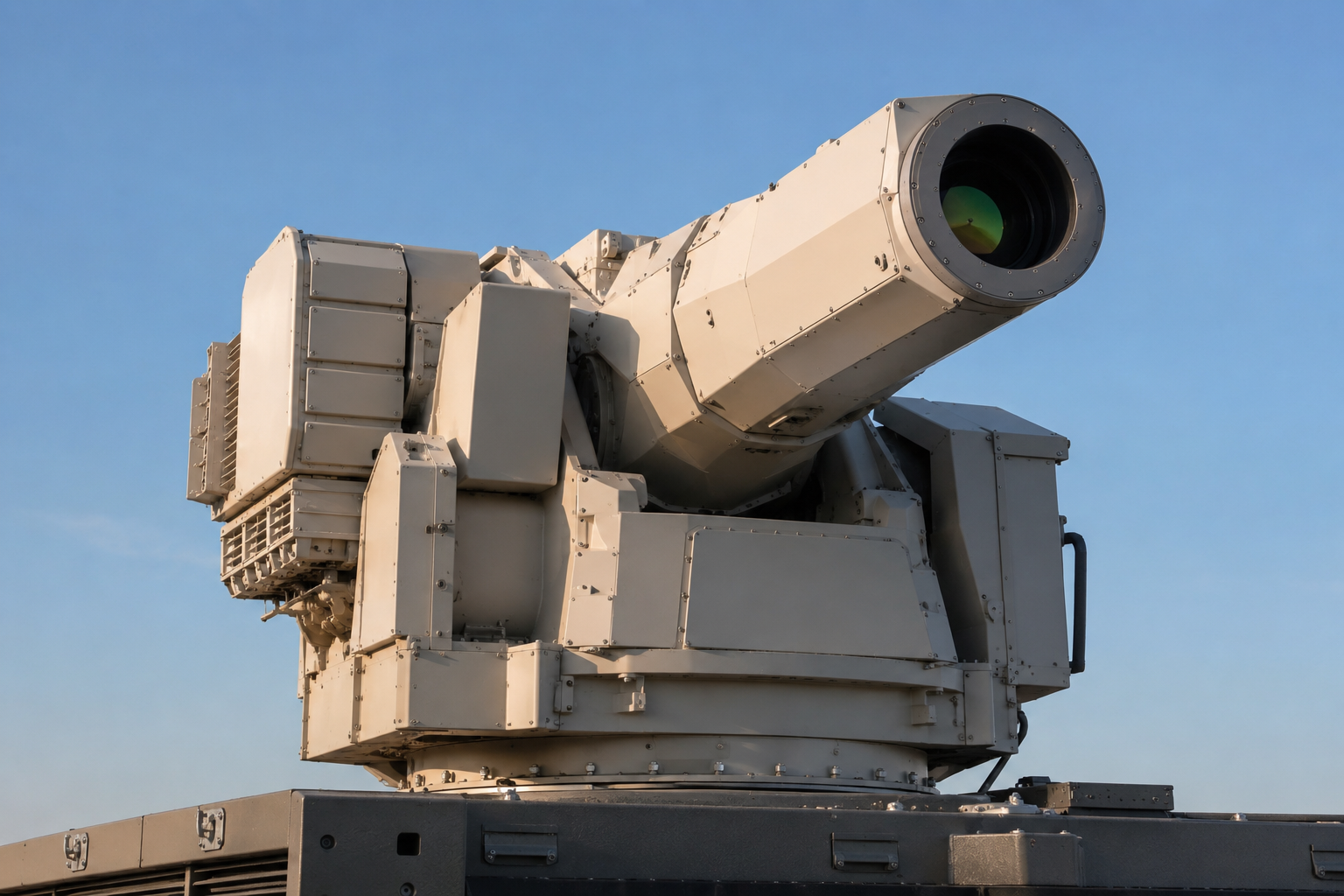
Batteries also supply pulse power, the requirement that defines directed-energy weapons: the delivery of a very large amount of electricity in a burst lasting seconds. A laser needs megawatts for the two or three seconds it takes to disable a drone, and no vehicle generator produces that on demand — so a bank of high-discharge batteries buffers the load, meaning it absorbs the mismatch between the steady output an engine provides and the sudden surge the weapon draws, charging gradually and releasing violently, as a camera flash does in miniature.
And batteries shorten fuel-supply lines — the convoys of tanker trucks that move diesel and aviation fuel from rear depots to forward positions, a vulnerability written into the casualty statistics of the Afghanistan war, where those convoys drew constant attack. NATO's own Smart Energy research found that hybrid-electric systems measurably reduce exposure to convoy strikes.
The US and UK have both pushed fully electric combat vehicles far into the future — charging infrastructure does not exist on a battlefield — while committing firmly to hybridisation. The modernised M1E3 Abrams tank treats its battery pack — the assembly of individual cells, wired together with the electronics that manage their charging and temperature, in which a vehicle carries its stored energy — as auxiliary power. Battery packs are, thus, reserved for command electronics, countermeasures, and future laser systems. The diesel engine is retained for mobility. This, in short, means that electrification is reserved for lethality. The emissions benefit that emerges from this is incidental.
The demand trajectory
Military lithium demand will track procurement doctrine — the body of decisions about what a military buys, and in what quantities, that follows from how it expects to fight. Today that doctrine means drone programmes, autonomy budgets and directed-energy projects, all compounding quickly; it no longer means net-zero pledges, which governments have set aside.
Expressed as a growth rate: forecasts anchored to the equipment programmes militaries were already running — radios, submarines, vehicles — imply roughly 4–5 per cent annual growth in the military battery market, while the projections published by battery suppliers themselves, who carry an evident interest in large numbers, reach 12.5 per cent. A defensible central estimate, weighting the spread of NATO drone programmes and land-fleet hybridisation, is 8–12 per cent compounded annually to 2035. At 12 per cent, demand doubles roughly every six years — and doubling a very small quantity still produces a very small quantity. Military use would claim under 3 per cent of global lithium demand in 2035.
The conclusion for forecasters is asymmetric. In tonnage models, "green weapons" can be ignored and even "electric weapons" barely move the total. In political models, the same electrification is decisive — because it has convinced the world's largest defence establishments that battery supply chains are war-fighting infrastructure. and they have begun to spend accordingly.
---
Next in the series: Part IV — When the Customer Becomes the Investor.
Principal sources: NATO communiqués and Smart Energy programme documents; Climate Home News reporting on COP26 (2021); Conflict and Environment Observatory / Scientists for Global Responsibility, military emissions estimates (updated August 2025); NATO Association of Canada, The Limits of Green Defence (July 2026); Grist reporting on Department of War climate policy (December 2025); Mordor Intelligence, M1E3 and land-systems analysis (2025); Aviation Week on Sion Power (2026).