The Expensive Business of Defending Oil---and What it Does, or Doesn't, Do for Lithium
Part 2 of 2: Second article reflecting on whether higher oil prices translate into greater demand for lithium.
GEOCONOMICS AND LITHIUM SUPPLY CHAINS
George Katito, PhD Geostratagem Research
6/4/202616 min read


In Brief
Lithium demand does not move in simple opposition to oil. When oil prices rise sharply — as they did when the Strait of Hormuz closed in March 2026 — governments and corporations face sharply higher energy costs, a stronger consumer case for electric vehicles, and a more urgent political argument for grid storage and renewable investment. All three effects create demand for lithium. But the same oil-price shock generates inflation that raises borrowing costs, which makes the upfront-heavy investment in renewable infrastructure more expensive to finance.
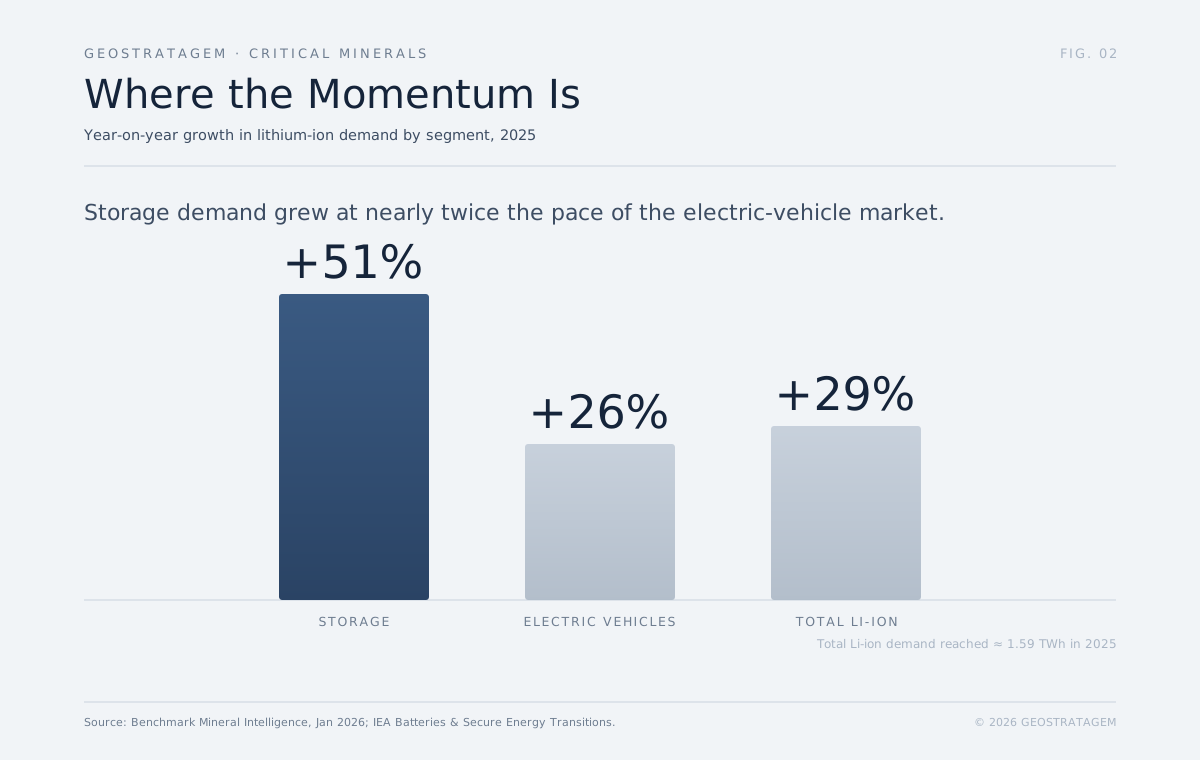
The fastest-growing source of lithium demand in 2025 was grid-scale battery storage — the technology that lets solar and wind power work reliably on electricity networks — which grew 51% against electric vehicle battery demand growth of 26%. By 2026, energy storage could account for 31% of total lithium consumption, up from 23% in 2025. This shift matters because storage demand follows the physics of integrating renewable energy into power grids rather than the price of petrol, giving it structural independence from oil price cycles.
Lithium demand faces genuine structural headwinds alongside its growth story, among them a trade environment increasingly shaped by US-China rivalry and export controls; emerging battery chemistries that may reduce lithium intensity over time; and green hydrogen as a long-duration storage alternative — though one with a cost structure that remains far from competitive.
The Thread from Article One
The first article in this series examined what the Iran war revealed about oil's cost structure and the assumptions energy markets had built on the reliability of the Strait of Hormuz. The structural question it left open was this: if the conflict has genuinely repriced the political cost of oil dependency across a large set of import-dependent economies, does that repricing translate into accelerated demand for the battery technologies that reduce oil exposure — and by extension, for the lithium those technologies require?
The answer this article works toward is: yes, measurably, and across more channels than the electric vehicle market that dominates public discussion. But the demand picture contains its own complications — technology competition, trade fragmentation, and supply dynamics that interact with the broader energy transition in ways that require a clear eye.
Electric Vehicles: The Anchor Market, Re-read
Electric vehicles consumed roughly 55% of global lithium demand in 2024, and the IEA projects they will account for approximately 86% of lithium demand growth to 2035. The channel matters enormously. It also attracts the bulk of commentary, sometimes at the expense of the demand vectors growing faster and with less dependency on any single government's policy posture.
China commands the EV market by a significant margin. Chinese new energy vehicle sales — covering both fully electric and plug-in hybrid cars — reached 12.87 million units in 2024, representing 40.9% of all domestic vehicle sales, rising to 13.88 million in 2025. Total production including exports reached 16.49 million units in 2025, up 28.2%. BYD held 34.1% of the domestic market in 2024. By December of that year, more than half of all new cars sold in China in a given month carried a plug.
State direction structured this market — a decade of purchase tax exemptions, subsidies, and a 45% market share target exceeded two years early — giving it a structural commitment that oil price movements touch only at the margin. Research tracking 36 Chinese cities over five years (He et al., 2025) quantifies that margin: a one-yuan-per-litre petrol price increase lifts EV sales by around 4.67%, with fully battery-powered cars responding more strongly than hybrids. The Hormuz shock moved oil well above the threshold at which that effect strengthens — but the Chinese EV market had already made its direction of travel clear, with or without any geopolitical catalyst.
In Europe, fully electric cars averaged 19% of new car sales in 2025, up from 15% in 2024, driven by EU rules requiring 22% of new registrations to be zero-emission vehicles. Volkswagen, BMW, Mercedes-Benz, Stellantis, and Renault all grew their market shares in 2025; several met their 2027 targets two years early. The IEA confirms that European fuel taxes cushion drivers so heavily from pump price swings that oil price movements produce a muted shift in European EV demand — regulatory obligation does most of the work.
The United States retreated. EV market share slipped from 8.1% to approximately 7.8% in 2025 as the second Trump administration withdrew purchase incentives and loosened fuel efficiency standards. Five major car manufacturers announced a combined USD 73 billion in write-downs on EV programmes. IEA cost-of-ownership modelling puts the relevant price threshold clearly: below roughly USD 50 per barrel, the financial case for electric vehicles weakens for most consumers; above it, EVs win on running costs. With oil near USD 104 per barrel at the time of writing, the consumer economics have never been more favourable. Washington's policy withdrawal came at the moment those economics strengthened most visibly — a timing that illustrates how the politics of the energy transition can run in the opposite direction to its economics.
The US case matters for the broader argument about oil and lithium: An administration that retreats from EV support while presiding over record domestic oil production demonstrates that fossil fuel primacy in transport is, in some markets, a political choice as much as an economic one.
Grid-Scale Battery Storage: The Fastest-Growing Channel and What It Takes to Keep Up
Global lithium-ion battery demand grew 29% in 2025, reaching approximately 1.59 terawatt-hours (TWh). Storage battery demand jumped 51%, against 26% growth in EV-related demand — a structural rebalancing toward stationary energy storage. In 2026, Benchmark Mineral Intelligence forecasts new operational Battery Energy Storage Systems (BESS) capacity exceeding 450 GWh, compared to 315 GWh in 2025, with over 150 gigawatt-scale projects in the pipeline. Some industry estimates suggest energy storage could account for around 31% of total lithium consumption by 2026, up from about 23% in 2025.
To put the scale in physical terms: one gigawatt-hour of storage — roughly the capacity of a large utility-scale installation — can supply approximately 300,000 average European homes for an hour. Each gigawatt-hour of installed storage requires approximately 900 tonnes of lithium.
The US installed 12.3 gigawatts / 37.1 GWh of battery storage in 2024, and the US battery storage market is expected to reach USD 7.02 billion by 2029 from USD 2.13 billion in 2024, at a compound annual growth rate of 26.8%. China crossed the 100 gigawatt milestone in total installed storage in 2025, making it the dominant market globally, while lithium-ion battery pack prices fell to USD 115 per kilowatt-hour in 2024 — 20% cheaper than 2023 and 84% lower than a decade ago.
Why does BESS demand behave differently from EV demand in its relationship to oil prices? The physics of electricity networks may partly explain this. Solar panels generate power when the sun shines; wind turbines generate power when the wind blows; electricity grids must deliver stable power at constant frequency and voltage at all times. Connecting large volumes of variable renewable generation to a grid operating on that requirement demands battery storage at every level: where generation meets the transmission network, inside industrial and commercial facilities, and embedded within the transmission infrastructure itself. The global BESS market is projected to grow from USD 50.81 billion in 2025 to USD 105.96 billion by 2030, at a compound annual growth rate of 15.8%, driven by renewable energy deployment, grid modernisation, and falling battery costs.
The Iran conflict has strengthened the political case for this investment without changing the underlying economics. Governments that watched their emergency fuel reserves fall short of what the disruption demanded now treat storage as a security procurement category rather than an environmental one. Security procurement tends to move on faster timelines than climate investment — a distinction with real consequences for the pace of deployment and therefore for lithium demand.
The scaling challenge is genuinely large. Meeting 450 GWh of new BESS capacity in 2026 alone requires roughly 405,000 tonnes of lithium dedicated to storage — compared to total global lithium production of around 1.2 million tonnes in 2024. That ratio grows as both storage deployment and demand from other sectors compound simultaneously. During the 2024–2025 price downturn, the number of feasibility studies for new lithium projects dropped from dozens annually to fewer than ten in 2025. That underinvestment in future supply has tightened the pipeline at precisely the moment that demand across multiple sectors begins compounding.
The Renewables Build: On Generation, Storage, and Lithium
The IEA's Renewables 2025 analysis projects solar and wind growing their share of global electricity generation by three to seven times across all scenarios by 2040. In 2025, solar and wind met all new global electricity demand growth through at least September. More than 90% of new renewable projects commissioned globally in 2024 were cheaper than new fossil fuel equivalents, per IRENA, the International Renewable Energy Agency. Global battery storage capacity additions grew at approximately 67% per year over the past decade. The cost competitiveness of renewables required no geopolitical crisis to establish. The Hormuz shock attached a security argument to a pre-existing economic one.
The solar panel supply chain adds a complication. Over 90% of global solar panel manufacturing sits inside China, a concentration the IEA projects persisting through 2030. China's export restrictions on lithium-ion batteries and graphite — key materials for the energy transition — emerged as a direct response to US tariff escalation in 2025, exposing how deeply global manufacturers depend on Chinese capacity. Governments diversifying their clean energy supply chains need both solar hardware and battery storage capacity from non-Chinese sources — and both require lithium. Which producers capture that demand depends on whether they can meet the provenance conditions attached to it.
In Europe, the EU Battery Regulation requires manufacturers to demonstrate responsible sourcing of lithium, cobalt, nickel, and graphite across their supply chains, with this obligation active since August 2025. From February 2027, every electric vehicle battery and large industrial battery sold in Europe must carry a digital Battery Passport — a verifiable record of where the materials came from, what carbon footprint the production process generated, and whether the supply chain met the EU's social and environmental standards. This regulation functions as a market filter, separating traceable supply from commodity supply at the point of sale. Producers who meet its requirements access the European market on full commercial terms; those who cannot face structural barriers regardless of how competitive their pricing.
Data Centres, Defence, and the Emerging Demand Frontiers
Battery energy storage is emerging as a major demand driver alongside EVs, propelled in part by AI data centres. Global investment in the US electricity grid jumped 9.5% in 2025 to USD 115 billion, driven substantially by data centre construction. Every large data centre requires battery backup systems that scale with computing load — not because engineers are especially enthusiastic about batteries, but because a data centre that goes dark during a grid fluctuation costs its operator more per minute than most people earn in a year. The IEA's 2025 battery market analysis placed data centres alongside automotive and grid applications as a growing source of lithium-ion demand. Precise figures for data centre lithium consumption remain unavailable in public reporting — the dataset is still forming — but every major AI facility built since 2024 carries embedded demand that did not exist five years ago.
The Iran conflict consolidated defence as a structurally significant demand category. Drone warfare featuring unmanned, battery-powered aircraft — deployed at scale by multiple parties — produced a live demonstration of lithium-battery-powered autonomous systems that defence procurement ministries worldwide will have studied carefully. The global drone battery market will grow from USD 1.59 billion in 2025 to USD 2.41 billion by 2030 at 8.7% annually. Defence procurement runs price-insensitive and increasingly specifies traceable supply chains — criteria that create a premium market for producers who can demonstrate auditable sourcing.
Humanoid robots — machines designed to operate in spaces built for people — shipped fewer than 10,000 units in 2025, equivalent to roughly 20 megawatt-hours of battery demand. The entire robotics segment accounted for less than 0.4% of global lithium-ion shipments. If annual deployments scale toward hundreds of thousands in the early 2030s, the addition becomes worth modelling. For now, it belongs in the monitoring column.
The Headwinds: What Could Keep the Demand Story from Running as Smoothly as the Numbers Suggest
The demand picture above is real and measurable. It also carries genuine structural challenges that any careful analysis should acknowledge — because they shape how quickly rising demand translates into value for the producers who supply it.
Trade policy fragmentation sits at the top of this list. The Trump administration imposed tariffs of 100% on Chinese electric vehicles, 25% on lithium-ion batteries and battery parts, 25% on other critical minerals, and 50% on solar cells. China responded by expanding export restrictions on battery-related materials and rare earths. In January 2025, China's Ministry of Commerce proposed restrictions on technology exports covering lithium salt production and the production of the battery-grade materials that most Western manufacturers currently rely on Chinese expertise to produce. A formal US national security review concluded that relying on imports of critical minerals — including lithium — poses an unacceptable security risk, opening the door to price floors, tariffs, and negotiated supply frameworks. The US also launched Project Vault in February 2026 — a USD 12 billion public-private initiative to procure and stockpile strategic minerals including lithium.
The result is a supply chain fragmenting along geopolitical lines: a China-aligned network and a Western-aligned one, each requiring its own infrastructure and generating its own costs. For producers sitting outside both blocs — including most African producers — this creates an opportunity in the form of multiple potential customer bases, but also the risk of being caught between rival compliance regimes with different provenance requirements, both of which require investment to meet.
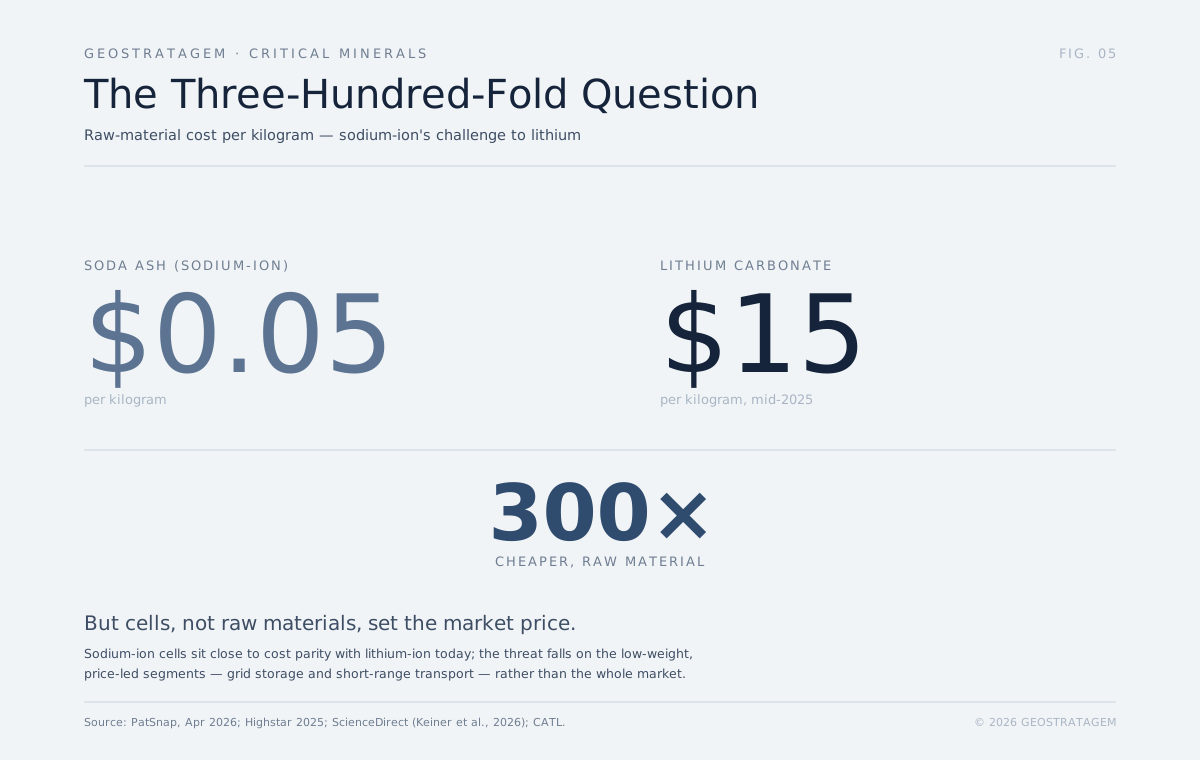
Sodium-ion batteries represent the most credible technology-based challenge to lithium demand growth. The raw material for sodium-ion batteries — ordinary soda ash, the same material used to make glass — trades at approximately USD 0.05 per kilogram, compared to lithium carbonate at USD 15 per kilogram as of mid-2025: a 300-fold difference in raw material cost. Total global sodium-ion shipments in 2025 were approximately 9 GWh — a small number relative to the overall market. CATL, the world's largest battery manufacturer, is mass-producing sodium-ion batteries on its "Naxtra" platform, targeting passenger vehicles from 2026 with a claimed driving range exceeding 500 kilometres on a single charge. Peer-reviewed modelling published in 2026 finds sodium-ion cells close to cost parity with lithium-ion today, with better prospects for cost reduction as production scales up.
Sodium-ion suits applications where keeping the weight down matters less than keeping the price down — grid storage, fixed industrial installations, short-range transport — which happens to be precisely the segment of lithium demand growing fastest. If sodium-ion captures a meaningful share of the battery storage market at commercial scale, it moderates lithium demand growth from the sector showing the most momentum. Whether that happens by the 2030s, as some analysts project, depends on how fast production scales and whether manufacturers find the supply chain simplicity worth the trade-off in energy density. It is a risk that may be worth incorporating into any forward projection for lithium.
Green hydrogen works differently, and understanding what it can and cannot do clarifies both its appeal and its current limitations. Green hydrogen gets produced by running an electric current through water — a process called electrolysis — which splits the water into hydrogen and oxygen. The hydrogen can then store energy over very long timescales and be used as a fuel in industrial processes, power generation, and heavy transport. This makes it attractive for applications where batteries run into physical limits: powering a steel plant, storing summer solar energy for winter use, or running a ship across an ocean. The problem, at present, is the cost. Green hydrogen production currently runs between USD 3.8 and USD 11.9 per kilogram — roughly two to five times the cost of conventional hydrogen produced from natural gas, which sits at USD 1.5 to 6.4 per kilogram. The cost gap reflects high electricity prices and the expense of the electrolysers — the equipment that does the splitting — which currently cost more than USD 2,000 per kilowatt of capacity.
Green hydrogen is not a near-term competitor to lithium-ion batteries for the storage applications driving lithium demand today. For the four-to-eight-hour storage window that most grid installations require, lithium-ion batteries already win decisively on cost. Green hydrogen becomes relevant at longer timescales — days or weeks of storage — where batteries become impractically large and expensive.
Academic research published in 2025 found that hydrogen functions as a viable complement to lithium batteries specifically in scenarios where lithium supply faces hard constraints, not as a replacement under normal market conditions. In practical terms: green hydrogen is more plausibly a future collaborator in the energy storage ecosystem than a competitor to lithium, and it will not meaningfully reduce lithium demand within the period that current supply deficit projections cover.
The Price Cycle: What the 2022–2026 Correction Tells Producers
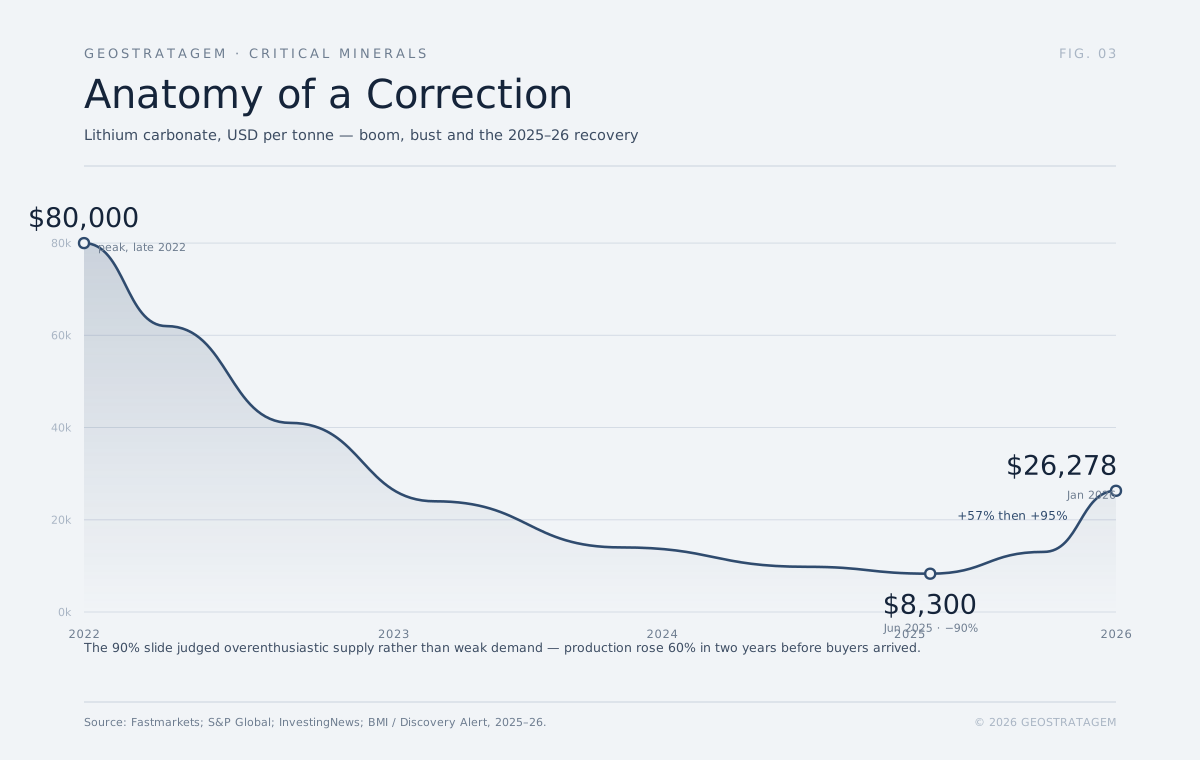
Lithium carbonate — the form of refined lithium most commonly used by battery manufacturers — peaked at roughly USD 80,000 per tonne in late 2022 and fell to approximately USD 8,300 per tonne by June 2025, a 90% decline. The commentary that followed treated this as a verdict on lithium's future. It was, more accurately, a verdict on overenthusiastic supply expansion: global production grew from around 737,000 tonnes to nearly 1.2 million tonnes on a comparable basis between 2022 and 2024 — a 60% increase in two years — as producers raced toward demand projections that the market had not yet reached. The surplus peaked at approximately 175,000 tonnes in 2023. Producers cut output, shelved projects, and reduced the number of feasibility studies for new mines from dozens annually to fewer than ten in 2025.
Prices recovered 57% between June and November 2025, then jumped a further 95% to reach USD 26,278 per tonne by January 2026 as three supply events converged: CATL suspended a major Chinese mine; Nigerian exports faced disruption; and Zimbabwe introduced its export ban on unprocessed ore, tightening hard-rock supply when buyers were already stretched. Fastmarkets' Paul Lusty described the moment as potentially "finally witnessing demand catch up with the supply surge of recent years," while noting that speculative buying had also pushed prices ahead of fundamentals.
The supply response from this point carries an important structural delay built into it. Australian producers — among the first to cut output during the downturn — require sustained prices above USD 1,000 per tonne of spodumene for at least six months before committing to a restart decision, and then a minimum of twelve months from that decision to actual production. That sequence means the supply response to any recovery in demand lags well behind the price signal — which is precisely the dynamic that creates a window in which demand compounds while supply cannot yet answer it.
BMI projects overall surplus conditions persisting through 2029 before a structural gap between supply and demand emerges across 2030–2035. The IEA's Critical Minerals Outlook 2025 confirms that on current investment trajectories, demand will outpace supply in the early 2030s.
One source of new capital deserves mention. Several major oil and gas companies — including Shell, BP, and a number of national oil companies — have made exploratory investments in critical minerals and lithium processing. The commercial logic reads as follows: If long-run oil demand declines under any credible energy transition scenario, energy companies face pressure to find revenue elsewhere, and lithium's demand trajectory offers an attractive destination for capital with extractive industry expertise. This migration of fossil fuel capital into lithium supply does not, however, solve the timeline problem — mining projects still take years from decision to production. It nonetheless injects capital and project development experience that was not previously engaged in the sector, which matters for whether the supply response to the early-2030s deficit arrives in time or late.
Upstream Producers and the Compliance Premium: Africa's Strategic Moment
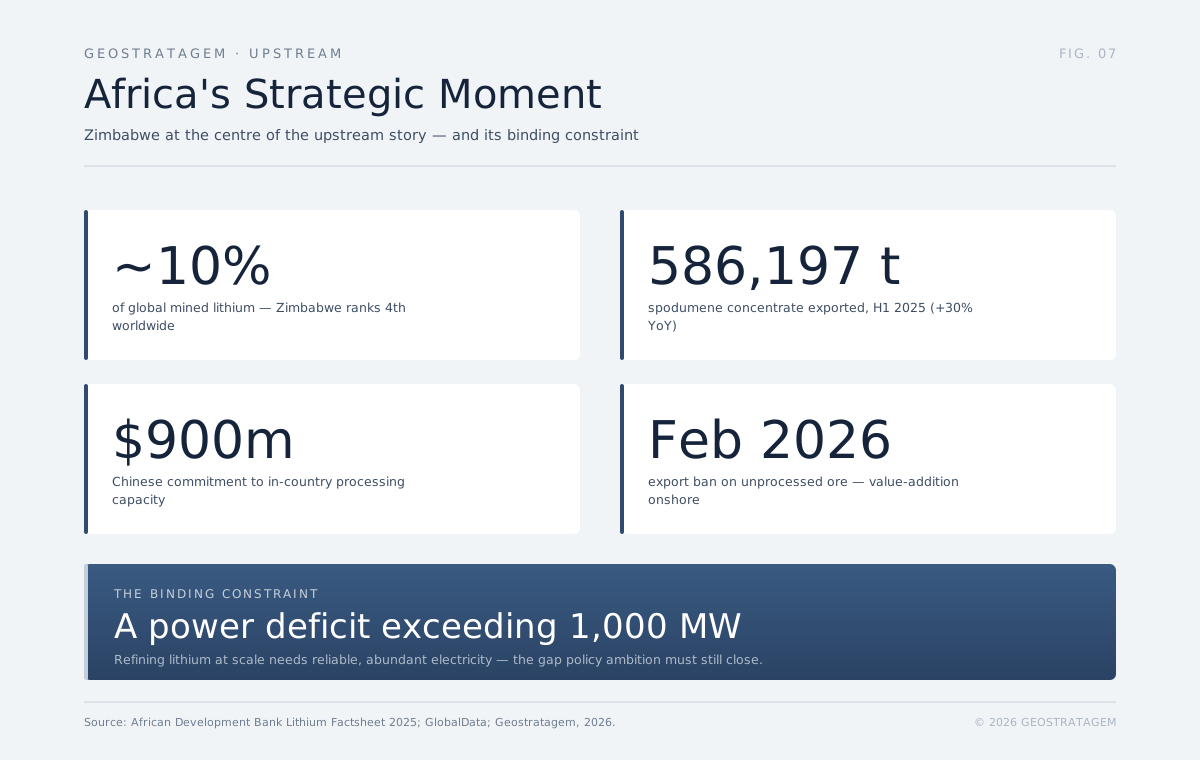
Africa's emergence as the world's leading source of new lithium supply in 2025 — with continental output exceeding every other region combined — reflects a shift in the geography of the mineral that sits at the centre of the energy transition. Zimbabwe, producing roughly 10% of global mined lithium and ranking fourth globally, expanded output through the price trough: spodumene concentrate exports reached 586,197 metric tonnes in H1 2025, 30% above the prior year, at a point when higher-cost producers elsewhere were retreating. Chinese investors have committed USD 900 million to in-country processing facilities, aiming to capture the refining margin that currently accrues inside China.
Zimbabwe's February 2026 export ban on unprocessed ore reflects the ambition to move value addition onshore — to export refined lithium chemicals rather than raw material. A key operational constraint in Zimbabwe at the moment is that it runs a power deficit exceeding 1,000 megawatts, with its principal hydroelectric source operating below rated capacity. Refining lithium at industrial scale ordinarily requires reliable, abundant electricity: This, then, imposes a gap between policy ambition and existing infrastructure that needs specific capital investment to close.
The broader point applies across producing countries: the premium market created by the EU Battery Passport rewards producers who can demonstrate traceable, responsibly sourced material — but the processing capacity, grid power, chain-of-custody systems, and governance structures required to access that market represent a different level of investment than simply expanding mine output. Commodity supply and premium supply are different businesses, with different capital requirements and different customers.
The Iran shock connects to Africa through the demand side. Import-dependent economies across Asia and sub-Saharan Africa, facing the sharpest price transmission from the Hormuz closure, carry the strongest political incentive to reduce oil dependency through electrification and renewable investment. Their transition away from fossil fuels sustains long-run demand for the battery materials that African producers supply. The scale and pace of that transition depends on investment capital, financing costs, infrastructure, and political will across a varied set of economies — none of which the conflict resolves automatically, but all of which the conflict has materially motivated.
Lithium demand rests on multiple compounding channels — electric vehicles, grid storage, renewable infrastructure, data centres, defence — each with its own sensitivity to oil prices, interest rates, and policy environments.
The Iran shock has strengthened the case across all of them without resolving the headwinds: trade fragmentation, technology competition, supply response delays, and financing costs remain live constraints. For producers positioned to serve the premium market — traceable, processed, compliant — the convergence of demand growth and supply underinvestment creates a real commercial opening. Capturing it requires resolving the infrastructure gaps that commodity positioning cannot bridge, and doing so within a window that supply restarts elsewhere are already beginning to narrow.
Demand by Segment: Reference Data
Electric vehicles: approximately 55% of global lithium demand in 2024; demand grew 26% in 2025; EVs projected to account for roughly 86% of lithium demand growth to 2035. Sources: IEA Global EV Outlook 2025; Benchmark Mineral Intelligence, January 2026.
Grid-scale battery storage: approximately 16–23% of global lithium demand in 2024–2025, rising to approximately 31% by 2026; demand grew 51% in 2025; 450 GWh new capacity forecast for 2026. Sources: Benchmark Mineral Intelligence; Carbon Credits; IndexBox, January 2026.
BESS market value: USD 50.81 billion in 2025, projected at USD 105.96 billion by 2030 at 15.8% CAGR. Source: MarketsandMarkets, 2025.
Portable electronics: approximately 6% of global lithium demand in 2024, declining to approximately 5% in 2025. Source: Benchmark Mineral Intelligence, January 2026.
Drone and defence batteries: USD 1.59 billion in 2025; USD 2.41 billion by 2030 at 8.7% CAGR. Source: MarketsandMarkets, 2025.
Sodium-ion competitive risk: approximately 9 GWh shipped in 2025; raw material approximately 300 times cheaper than lithium carbonate; may compete with low-cost lithium-ion by the 2030s under specific conditions. Sources: Highstar, 2025; PatSnap, April 2026; ScienceDirect, 2026.
Green hydrogen production cost: USD 3.8–11.9 per kilogram, compared to conventional hydrogen at USD 1.5–6.4 per kilogram; electrolyser capital costs exceed USD 2,000 per kilowatt. Sources: Springer Nature, 2025; Lazard Levelised Cost of Hydrogen analysis.
Long-run aggregate demand: approximately 130,000 tonnes on a comparable basis in 2022; approximately 30% demand growth in 2024; IEA baseline projects 1,382,000 tonnes per year by 2045. Source: IEA Critical Minerals Outlook 2025.
Sources: CAAM, January 2026; CPCA, 2025; ICCT, January 2026; IEA Global EV Outlook 2025; IEA Critical Minerals Outlook 2025; IEA Batteries and Secure Energy Transitions, 2024; IEA Renewables 2025; Benchmark Mineral Intelligence, January 2026; Carbon Credits, January 2026; IndexBox, January 2026; Fastmarkets, March 2026; BMI / Discovery Alert, May 2026; S&P Global, January 2026; InvestingNews, April 2026; BloombergNEF; MarketsandMarkets BESS Market Report 2025; MarketsandMarkets Drone Battery Market Report 2025; Fortune Business Insights; Future Market Insights; GlobalData, July 2025; African Development Bank Lithium Factsheet, 2025; Sprott Insights, March 2026; ODI, 2026; Rhodium Group / CEEPR, November 2025; Taylor and Francis, 2025; PatSnap, April 2026; Highstar, 2025; ScienceDirect Keiner et al., 2026; Springer Nature, 2025; Lazard Levelised Cost of Hydrogen; He et al. (2025), ScienceDirect, doi:10.1016/j.eneco.2025.108002; CSIS, March 2026; EIA, May 2026.