The 600 Million-People Question: Can Renewables Bridge Africa's Energy Gap?
Six hundred million people in Africa live without electricity. Set against the continent's demographic and economic trajectory, that figure is one of the most revealing numbers in African geopolitics: it measures both the chief constraint on Africa's rise and an opportunity to be seized.
ENERGY STORAGE AND ELECTRIFICATIONGEOPOLITICSHUMAN IMPACT
George Katito, PhD
6/22/202611 min read
In Brief
Africa's electricity gap — roughly 600 million people, 47 per cent of Sub-Saharan Africa's population — deserves to be read as a strategic measurement, rather than a simple humanitarian one. The continent's working-age population will nearly double to 1.6 billion by 2050; its consumer and business spending is projected to reach $16 trillion; its cities are growing faster than any in the world. The 600 million figure, arguably, measures the distance between Africa's projected weight in the world economy and the infrastructure needed to carry it.
The world's major powers have noticed, and that changes what the energy gap means for African governments. Washington has rebuilt its Africa policy around trade deals rather than aid; Beijing redirected its solar industry southwards, shipping 18.8 gigawatts of panels to Africa in 2025 — 48 per cent more than the year before; Brussels has assembled multi-hundred-million-euro renewable energy packages. All three have grasped the same point: the African market they are courting cannot exist without power. For African states, electricity has therefore become a matter of statecraft — a source of bargaining power with three suitors at once, and a serious vulnerability if mishandled.
So, can renewables bridge the gap? On the evidence, yes for homes and small businesses — and a more cautious yes, with conditions, for industry. Solar power now costs as little as three US cents per kilowatt-hour, cheap enough that a panel pays for itself in months by replacing diesel; African consumers bought a record 10.2 million off-grid solar systems in 2025. Powering factories, mines and cities is a harder problem: it requires roughly six times more investment each year than currently arrives — $15 billion against today's $2.5 billion — and electricity utilities healthy enough to handle it. The opportunities — and risks — are as large as the gap itself.
The Measurement That Matters
The International Energy Agency's October 2025 study, Financing Electricity Access in Africa, puts the population without electricity at roughly 600 million — 47 per cent of Sub-Saharan Africa. Progress has stalled: fewer than 19 million people gained a connection in each of 2023 and 2024, down from 23 million in 2019, with new connections barely keeping pace with population growth. Three countries — Nigeria (roughly 86 million people without power), the Democratic Republic of the Congo (79 million) and Ethiopia (56 million) — account for nearly 40 per cent of the world's entire unconnected population. The average African consumes about one-sixth as much electricity as the average human being.
Take the population figures next: Africa's 1.55 billion people in 2025 will approach 2.5 billion by 2050 — roughly a quarter of humanity, and comfortably its youngest quarter. The working-age population alone nearly doubles, from 883 million in 2024 to 1.6 billion at mid-century. Then the economic figures: the Brookings Institution projects combined consumer and business spending of $16.12 trillion by 2050, with the continent's growth (4.2 per cent forecast for 2025) consistently outpacing the world's. The African Continental Free Trade Area — the largest free trade area by membership since the founding of the World Trade Organization — could lift trade between African countries by 15 to 25 per cent by 2040. Finally, the geography: Africa is urbanising faster than any other region, concentrating future demand in cities whose power grids were often engineered for a fraction of their present populations.
Each of these projections is routinely quoted. All of them assume electricity that does not yet exist. A workforce of 1.6 billion stands to be an asset through machines, computers and cold chains — all of which need power. Sixteen trillion dollars in spending presumes shops and firms that can refrigerate, automate and stay open after dark. Thriving cities presume grids that function. The IEA expects African electricity demand to grow by more than half by 2040 — yet on current investment levels, it also projects around 500 million people still unconnected in 2030. The 600 million figure is, perhaps, part of the gap between Africa's projected strategic weight and the infrastructure required to realise it.
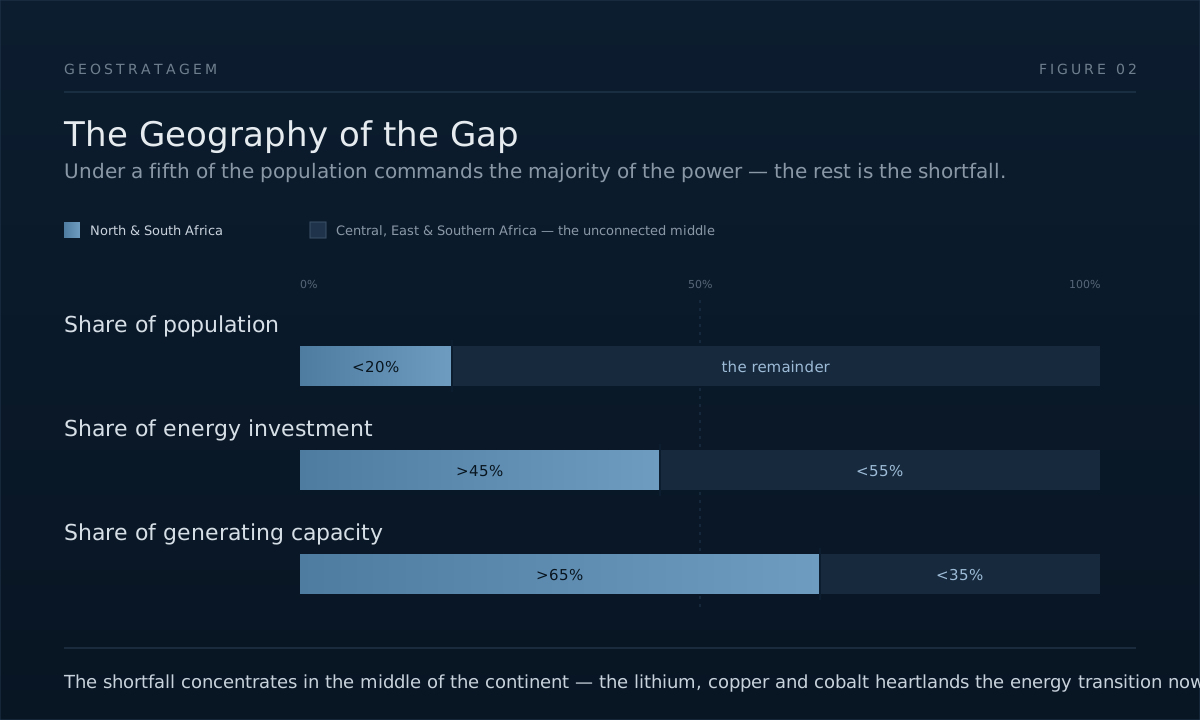
The geography of these numbers is instructive: South Africa and North Africa, home to under 20 per cent of the continent's population, attract more than 45 per cent of its energy investment and hold over 65 per cent of its generating capacity. The shortfall concentrates in the middle of the continent — the lithium, copper and cobalt heartlands of Southern, Central and East Africa — which happens to be exactly where the global energy transition's appetite for minerals, and hence the attention of the major powers, now falls.
Energy and Statecraft
The repositioning of the three largest outside powers has changed what the energy gap means for African governments.
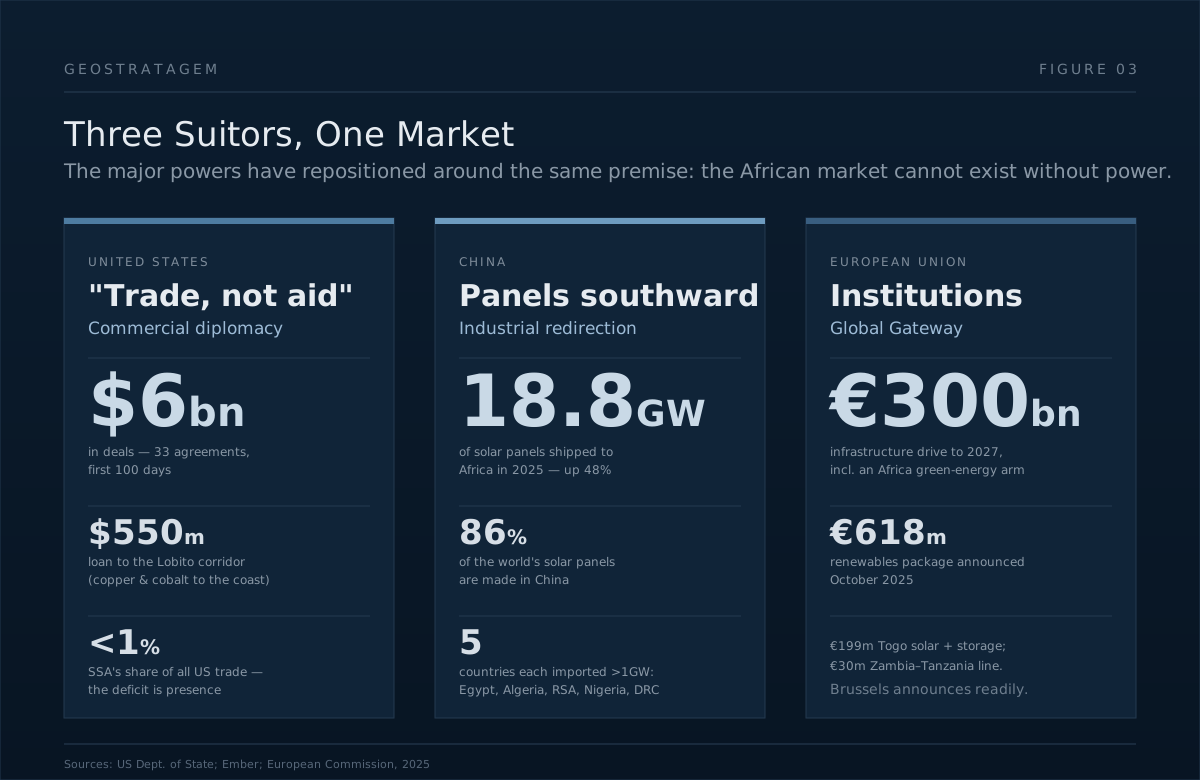
The American shift is the most explicit. In May 2025, the State Department's senior Africa official, Troy Fitrell, launched a Commercial Diplomacy Strategy in Abidjan built on the phrase "trade, not aid": American ambassadors across Africa would now be judged on the business deals they helped conclude, with diplomatic effort directed at infrastructure projects sound enough to attract commercial finance. Fitrell claimed 33 agreements worth $6 billion in the administration's first hundred days.
The cost of the policy shift continues to be felt: the dismantling of the United States Agency for International Development (USAID) did well-documented damage to health and humanitarian programmes, and the lapse of the African Growth and Opportunity Act — the law granting many African exports duty-free access to the American market — in October 2025 has clouded the trade picture, though an extension is moving through Congress. Still, the strategic signal is easy to read. American exports to Sub-Saharan Africa amount to less than one per cent of all American trade; Washington has concluded that its real deficit in Africa is commercial presence. Its $550 million loan to the Lobito rail corridor — built to carry Zambian and Congolese copper and cobalt to the Atlantic coast — shows energy and minerals at the centre of the correction.
Beijing's repositioning is industrial rather than rhetorical. As tariff walls rose around the American and European markets, Chinese manufacturers — who make roughly 86 per cent of the world's solar panels — sent their products south. The energy think tank Ember records African imports of Chinese panels at 18.8 gigawatts in 2025, up 48 per cent in a year and equivalent to more than three times the capacity of the Grand Ethiopian Renaissance Dam, the continent's largest power station. Five countries — Egypt, Algeria, South Africa, Nigeria and the DRC — each imported more than a gigawatt. China's engagement with Africa, long organised around mines and lending, increasingly reaches directly into African households and businesses as customers.
The European Union, Africa's longest-standing commercial partner, has answered with institutions. Its Global Gateway programme — a €300 billion infrastructure investment drive running to 2027 — includes a dedicated Africa-EU green energy initiative, and in October 2025 the European Commission announced a further €618 million for renewable energy across the continent, from a €199 million solar-and-storage project in Togo to a €30 million transmission line connecting the Zambian and Tanzanian grids. Brussels announces more readily than it disburses, as critics of Global Gateway have observed; but the direction of travel matches Washington's and Beijing's.
For African states, the implication cuts both ways. Three competing pools of capital, technology and political attention can be played against one another — a position any student of Cold War non-alignment would recognise. But the leverage comes with exposure. Power infrastructure built with one bloc's money, standards and equipment is expensive to walk away from, and a country that solves its electricity deficit by becoming a piece of someone else's strategy has traded one problem for another. Either way, the conclusion stands: electricity is growing to be critical to African statecraft.
The Central Question: Can Renewables Bridge the Gap?
The question needs splitting in two, because "the gap" is really two different problems dressed as one statistic. The first is the access gap: homes and small businesses with no connection at all. The second is the reliability gap: countries that have grids, but grids too weak or erratic to support factories, mines and growing cities. Renewables answer the two in distinct ways.
On the access gap, three sets of numbers point in the same direction.
The first is price. Solar panel prices fell 40 to 50 per cent in just eighteen months, bringing the cost of solar electricity down to roughly three US cents per kilowatt-hour — cheaper than diesel, and cheaper than what many African utilities charge — on a continent holding an estimated 60 per cent of the world's best solar resources.
The second is trade. Ember's import data shows 15 gigawatts of panels entering Africa in the year to June 2025, a 60 per cent increase, and the surge is broad rather than concentrated: imports outside South Africa tripled in two years, twenty countries set national records, and 25 countries imported at least 100 megawatts. Sierra Leone alone imported panels equivalent to 61 per cent of everything its grid generated in 2023.
The third is what consumers are actually doing. GOGLA, the off-grid solar industry association, recorded 10.2 million solar systems sold in 2025, more than 90 per cent of them in Sub-Saharan Africa — with most now bought in instalments over mobile money (the model known as pay-as-you-go), which grew 48 per cent and overtook cash purchases for the first time.
The economics underneath are easy to discern: in Nigeria, Ember calculates, the diesel a panel replaces pays for the panel within six months. In nine of the ten biggest importing countries, the national fuel import bill exceeds the solar import bill by somewhere between 30 and 107 times. The demand is observable,with people already paying for energy at diesel prices.
On the reliability gap, the honest answer is: yes, if two conditions are met — and neither is technical.
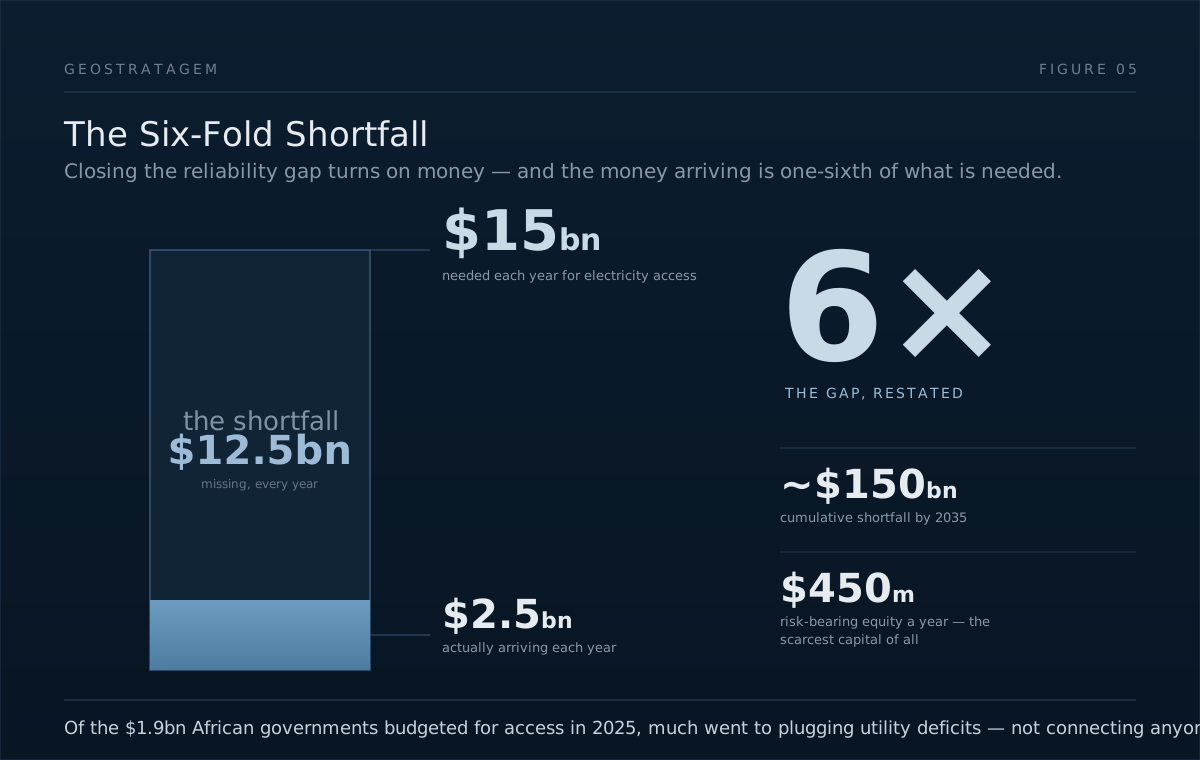
The first condition is money. The IEA's first systematic count of electricity-access investment in Sub-Saharan Africa found under $2.5 billion arriving each year, against an estimated need of $15 billion — a six-fold shortfall, adding up to some $150 billion by 2035. Risk-bearing investment is scarcest of all: equity averages just $450 million a year, most of it going to established firms rather than the young companies driving the market.
The second condition is institutional. Sub-Saharan Africa's state electricity utilities are among its most indebted public enterprises, caught between politically suppressed tariffs, unpaid bills and high costs; of the $1.9 billion African governments budgeted for electricity access in 2025, much went to plugging utility deficits rather than connecting anyone. And industry adds a problem that households can sidestep: the sun sets. Factories and mines need power through the night, which means batteries, transmission lines and steady sources to run alongside solar — Kenya's geothermal fields, hydropower traded across borders through the Southern African Power Pool, and new connections like the Zambia–Tanzania line now drawing European finance.
The recent experience of Zimbabwe and Zambia shows why that steadiness matters — and why solar entered the argument in the first place. Both countries lean on Kariba, the great hydroelectric dam they share on the Zambezi. Southern Africa's worst drought in four decades drained the reservoir to roughly three per cent of usable storage by January 2025, leaving the Zimbabwean side generating 252 megawatts from machinery built for 1,050.
Zimbabwe's installed capacity of about 2,700 megawatts nominally covers its peak demand of 2,200 — yet actual supply averaged closer to 1,200 megawatts once the hydro losses combined with constant breakdowns at the ageing Hwange coal plant. Power cuts ran past 18 hours a day, and past 21 in Zambia, where hydropower supplies roughly 84 per cent of the grid.
The drought underscored three critical points : the old renewable (water) is fragile thanks to climate change; the old thermal fleet (coal) is unreliable; and the case for solar as the fastest way to diversify is justified.
In essence, renewables — overwhelmingly solar, bought and financed close to the point of use — can plausibly close most of the household and small-business gap within a decade, because price, supply and proven demand are already aligned.
They can close the industrial gap only if investment expands roughly six-fold and the utilities and rules governing power are rebuilt around it. The first proposition is being demonstrated in real time, ten million systems a year. The second remains a daunting forecast.
Mapping the Opportunity and Counting the Cost
Analysed this way, the gap amounts to one of the most legible commercial openings in the world economy: the largest concentration of unserved, paying energy demand anywhere; consumption at one-sixth of the world average, growing by half again before 2040.
The $12.5 billion annual investment shortfall looks, from an investment perspective like a market starved of capital whose end customers already pay diesel prices for an inferior product. And pay-as-you-go solar — an African invention, fusing the continent's mobile-money systems with its distribution entrepreneurs, now reaches an estimated 148 million people.
Zimbabwe condenses the case:
The regulatory groundwork has been done: most solar equipment enters duty-free; rooftop installations are largely hassle free, independent power producers — private generators selling electricity — are welcome. The national target is 2,640 megawatts of renewable capacity by 2030. Companies have moved first: the cement maker PPC and the gold miner Caledonia have built solar plants for their own operations, and licensed private projects approaching a gigawatt have queued up behind them.
A robust lithium-led mining sector will continue to need reliable power and will sign long contracts to secure it; businesses already pay generator prices.
Risks, however, emerge from several quarters There's borrower's risk. Some twenty African countries are in, or close to, debt distress, and Zimbabwe in particular borrows at rates that price many projects out of international markets. Earning revenue in hard currency — from mining customers, say — softens this without necessarily eliminating it.
Customer's risk. If an electricity project's only customer is an insolvent state utility, the project inherits the utility's troubles. Selling power directly to households and firms is partly a hedge against exactly this — though every customer the utilities lose makes their finances worse. Starved and cornered monopolies have been known to reach for defensive regulation.
Supplier's risk. The equipment comes overwhelmingly from one country: China, with its 86 per cent share of world panel production. Factories now rising in Egypt, Morocco and South Africa will dilute that only slowly.
Household's risk. The shift from cash purchases to instalment plans signals stretched consumers as much as financial innovation; whether millions of new instalment customers keep up their payments is yet to be determined.
System's risk. Kariba has already shown what drought does to a grid built on water. A grid built on sunshine will, at scale, face its own version of the question every evening — and although battery prices are falling along the same curve that panel prices did, the batteries are arriving more slowly than the panels.
None of these risks is disqualifying; all of them can be priced. The analytical error would be to let either half of the ledger crowd out the other.
Conclusion
Can renewables bridge Africa's energy gap? The question needs to be split properly for a satisfactory response: yes for homes and small enterprises, on economics already proven at the scale of ten million systems a year; conditionally for industry, where closing the gap ultimately depends on a six-fold expansion in investment and on institutional reform that great-power competition now makes likelier, though hardly certain.
The 600 million figure will remain one of the most strategically informative number on the continent for the coming decade. Bridging the gap will depend on governments treating 600 million as a bargaining position, and the investors approaching it as a real market with a known list of risks.
Sources
- International Energy Agency, Financing Electricity Access in Africa, Paris, October 2025.
- International Energy Agency, World Energy Investment 2025 (Africa chapter), Paris, 2025.
- International Energy Agency, World Energy Outlook 2025, Paris, November 2025.
- Ember, The First Evidence of a Take-off in Solar in Africa, London, August 2025.
- Ember, Global Electricity Review 2026, London, April 2026.
- GOGLA, The 2025 Global Off-Grid Solar Market Report, Amsterdam, 2026.
- GOGLA, Sales and Impact Data, January–June 2025, Amsterdam, 2025.
- U.S. Department of State, Remarks for Launch of Bureau of African Affairs Commercial Diplomacy Strategy, Abidjan, May 2025.
- U.S. Department of State, America First in Africa, Bureau of African Affairs, March 2026.
- Center for Strategic and International Studies, Which U.S. Government Agencies Are Facilitating the Trump Administration's Commercial Diplomacy in Africa?, Washington DC, December 2025.
- European Commission, President von der Leyen Announces €618 Million Package to Scale Up Renewables in Africa, Brussels, October 2025.
- European Commission, EU–Africa Global Gateway Investment Package, Directorate-General for International Partnerships.
- United Nations Economic Commission for Africa, As Africa's Population Crosses 1.5 Billion, the Demographic Window Is Opening, Addis Ababa, 2024.
- Brookings Institution, Foresight Africa 2025–2030, Washington DC, 2025.
- Zambezi River Authority, hydrological updates on Lake Kariba, 2024–2025.
- Zimbabwe Energy Regulatory Authority (ZERA), licensing and net metering frameworks; Electricity (Net Metering) Regulations, 2018.
- Reuters, US Shifting Africa Strategy to 'Trade, Not Aid', Envoy Says, May 2025.