Minding the 19:1 Gap: How the Cheapest Fix in the Lithium Supply Chain Costs About a Textbook
The gap between the low revenues currently gained by lithium producing countries and the significantly higher potential inflows is a reflection of a technical skills gap in rural African education.
HUMAN IMPACTEDUCATION
George Katito, PhD
3/11/20268 min read
In Brief:
The massive 19:1 price disparity between raw lithium ore and battery-grade lithium carbonate highlights a fundamental issue beyond just processing technology: a critical shortage of local, technical labor—specifically chemists and analysts—in the mining regions. This labor shortfall forces resource-rich countries to export raw materials and, consequently, their potential economic value.
The core of the problem lies in the failing local educational pipeline. Rural school curricula often fail to establish practical relevance, neglecting to link subjects like chemistry directly to the operations of local mines. This disconnection, compounded by unreliable essential infrastructure, especially electricity, makes hands-on science education virtually impossible, effectively blocking the local pathway to skilled employment.
Crucially, efforts to "beneficiate" (process resources locally) are consistently hampered because the single most important component—the local education system—is entirely overlooked in current global supply chain models. Without strategic investment in this foundational "Level 0" node, the "resource curse" may persist, with economic value draining out through the necessity of importing costly foreign expertise.
The classroom that shapes the lithium chain
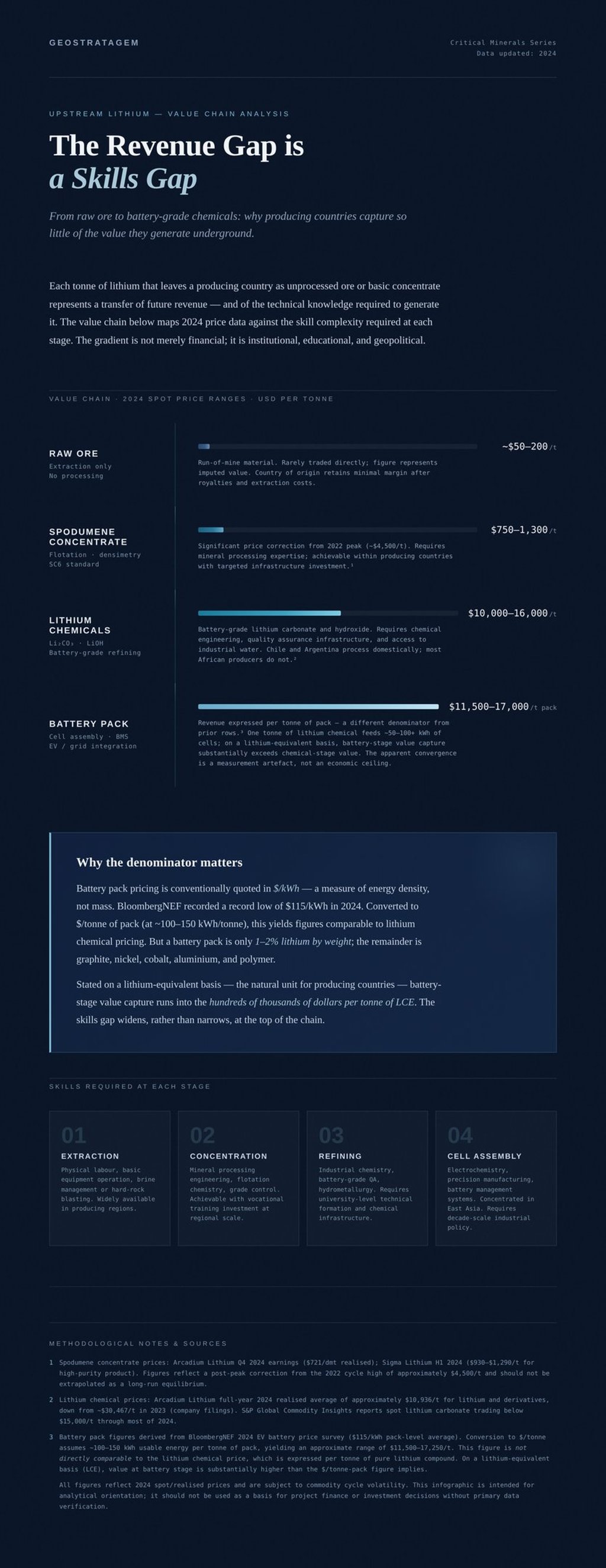
Lithium ore from places like rural Zimbabwe sells for a few hundred dollars per tonne, but once it is processed into battery-grade lithium carbonate it can sell for around 14,000 dollars per tonne. That roughly 19:1 gap is what governments call “beneficiation” — keeping more of the value-adding steps at home instead of exporting raw rock.
To do that, countries need more than mines and capital; they need a technical workforce able to run complex chemical plants and monitor environmental impacts. That workforce is supposed to come from local secondary schools and vocational colleges in the rural districts where the deposits sit — but today, those schools are the weakest, most ignored part of the chain.
1. How the price gap is really a skills map
Spodumene concentrate with about 6% lithium oxide content (SC6) traded around 730–830 dollars per tonne in 2024, while battery-grade lithium carbonate averaged about 14,000 dollars per tonne. That spread is not just about technology and capital; it encodes different types of labour at each stage.
At the mine and basic “physical beneficiation” stage (crushing, flotation, drying), most jobs are semi-skilled: machine operators, maintenance workers, basic lab assistants.
At the chemical conversion stage (roasting, acid leaching, purification, carbonation to tight impurity specs), you suddenly need process chemists, lab analysts, water and waste technicians, and safety and environmental officers with solid backgrounds in applied science and maths.
In shorthand: At 730 dollars per tonne, the chain wants operational labour. At 14,000 dollars per tonne, it wants technical labour.
That technical labour is the product of an education system, and in lithium regions that system is overwhelmingly rural.
2. Education, earnings, and why quality matters more than enrolment
Economists have shown for decades that each extra year of schooling tends to raise individual earnings, often by 5–15% per year in developing countries, with technical and professional tracks at the high end. In mining-heavy economies, technical qualifications can easily double or triple wages compared to unskilled mine work.
But later research stresses that what really matters is learning, not just sitting in a classroom. Countries that boost enrolment without improving the quality of teaching and actual cognitive skills see much smaller gains in income and growth.
Zimbabwe provides a case-in-point: it has one of the highest literacy rates in sub-Saharan Africa, yet studies in rural mining districts show a big gap in applied technical skills among secondary students. Students may pass exams, but they are not prepared to step into demanding technical roles in nearby mines and plants.
3. Zimbabwe: big reserves, blocked pipeline?
Zimbabwe has the largest known lithium reserves in Africa and has seen volumes and investment surge in recent years, including from Chinese mining and processing companies. The government plans to ban exports of lithium concentrates from 2027 onward to force more local processing.
Yet fieldwork around major deposits such as Bikita shows that local residents generally lack the qualifications to compete for skilled jobs in the sector. Most technical and supervisory positions are held by expatriate staff, while local workers are concentrated in lower-paid, semi-skilled and unskilled roles or in auxiliary activities like packaging and tailoring. Labour groups report that wage levels and hiring patterns send weak signals to families that investing in advanced technical schooling for their children will pay off.
4. The curriculum problem: content without context
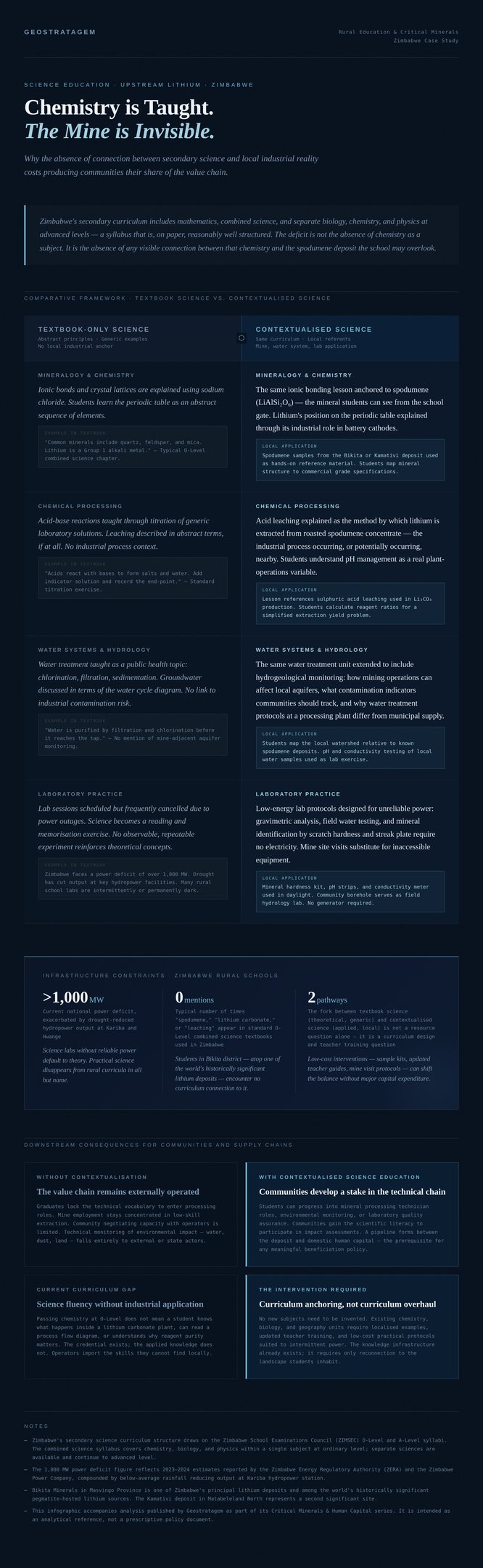
On paper, Zimbabwe’s secondary curriculum is reasonably well structured for science. Pupils must take mathematics, English, an indigenous language, combined science, and heritage studies, with biology, chemistry, and physics available as separate subjects and continuing into advanced levels.
The issue in rural mining areas is not the absence of chemistry as a subject, but the absence of connection between relevant subjects and local reality.
Students in a school that overlooks a spodumene mine may never see that mineral named or used as an example in their textbooks.
Processes like acid leaching, water treatment, and hydrogeological monitoring are taught, if at all, in abstract terms with no tie to the plants and aquifers that students’ communities depend on.
Infrastructure makes this worse. Zimbabwe currently faces a power deficit of over 1,000 MW, and drought has sharply cut output at key hydropower facilities, giving many rural schools unreliable electricity. That means lab-based science teaching is intermittent or absent, turning science into a theoretical exercise instead of a practical preparation for industrial work.
5. Where the pipeline breaks
Zimbabwe does have post-secondary technical institutions tailored to mining, such as the Zimbabwe School of Mines, which offers diplomas in mine geology, metallurgy, and mine surveying. These programmes teach exactly the kinds of skills needed for geological mapping and environmental monitoring.
The problem is the bridge between rural secondary schools and these programmes. A student who passes O-Level chemistry without doing real experiments, and without ever seeing how that chemistry links to the mine down the road, may technically meet entry criteria but is practically underprepared. The result is a leaky pipeline: many students either never apply, drop out, or struggle to complete, and companies fill the resulting gap with imported specialists.
Countries like France have responded to similar issues with two-year applied technical diplomas (BTS) that blend rigorous science with workplace placements, sitting between school and a full university degree. Zimbabwe’s own diploma structure is close to this in form, so the task is to strengthen preparation at secondary level and extend the range of technical diplomas explicitly into processing chemistry and environmental and social monitoring — not just mine geology.
6. The missing nodes in standard lithium models
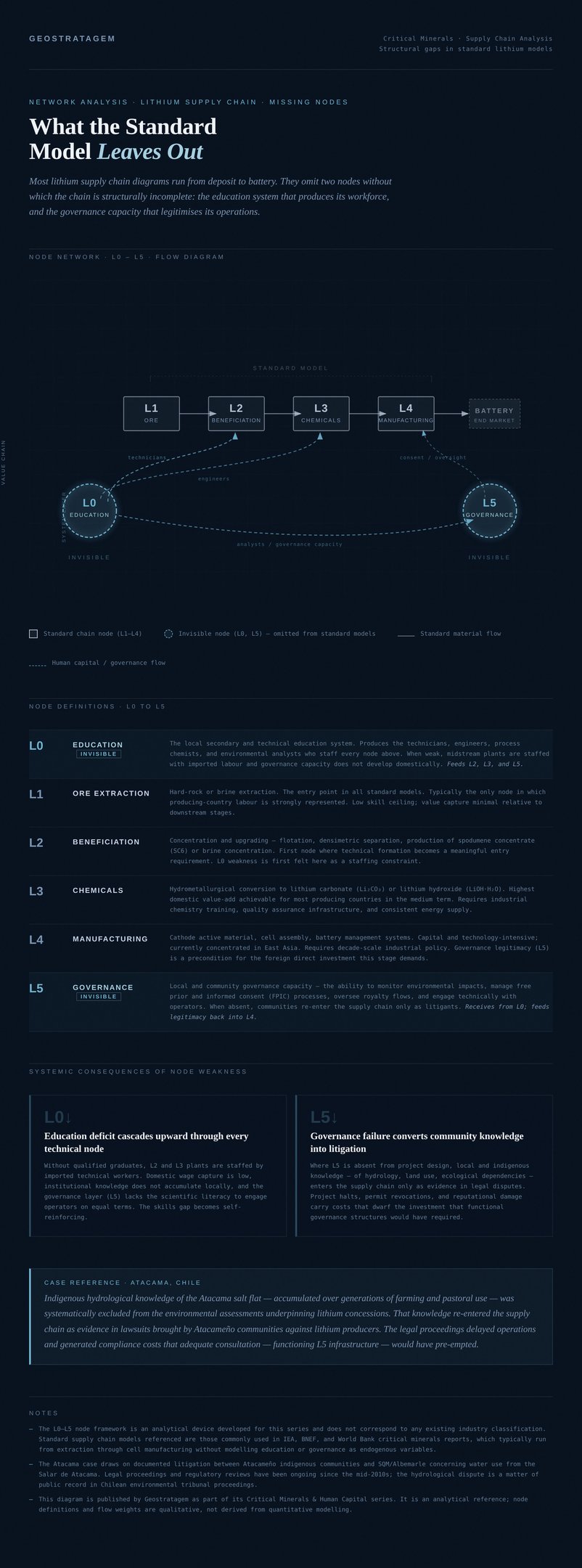
Most lithium supply chain diagrams go like this: Deposit → Beneficiation plant → Chemical conversion → Cathode and cell manufacturing → Battery.
What they leave out are two critical “invisible” nodes: Level 0: the local education system that produces technicians, engineers, and analysts.
Level 5: local governance and community capacity — people who can monitor environmental impacts, manage consent processes, and oversee royalties.
When Level 0 is weak, there are not enough qualified people to staff midstream plants or to feed into governance. When Level 5 is weak, communities fall back on litigation or protest when things go wrong, which can halt projects at enormous cost. A widely cited example from Chile’s Atacama shows how indigenous hydrological knowledge, ignored in project design, later came into the supply chain only as evidence in lawsuits against lithium producers.
7. Bottlenecks and the “resource curse” in network form
Systems theory says any chain is only as strong as its weakest link. In network terms, the throughput of a system is capped by its tightest bottleneck, so pumping money into other parts of the system does not increase overall output until that bottleneck is fixed.
In Zimbabwe, billions are flowing into new concentration and chemical plants while Level 0 — rural technical education — remains underbuilt. The result is a classic bottleneck: heavy investment downstream, but still a shortage of local technicians, so companies import labour and the country captures less of the wage and knowledge benefits than it could.
The “resource curse” literature describes something similar at the national level: economies that lean heavily on raw commodity exports tend to grow more slowly in the long run, especially when most of the value-adding steps happen abroad and governance is weak. In the network picture, this looks like a graph where Level 1 (the mine) connects almost straight to exports, skipping Levels 2, 3, and 5.
Botswana is a standout example of how to escape this pattern. Decades of deliberate investment in scholarships, technical training centers, and university partnerships tied to its diamond industry have built strong links from education into operations, processing, and governance, and new licence deals explicitly include vocational training commitments.
8. Why sensible reforms keep stalling
Reports, strategies, and company filings often acknowledge skills shortages in mining districts, yet the situation barely moves. One reason is that “education policy” is not controlled by a single ministry but is,in reality, an outcome of a web of actors.
That web includes national curriculum bodies, regional bureaucracies, school leaders, teachers trained for urban exam conditions, mining HR departments, parents and students, and also hard infrastructure like textbooks, labs, and the electricity grid.Any one of these can weaken or distort reform efforts if new plans do not align with their immediate interests or capacities.
A striking example is electricity. Zimbabwe’s power shortages mean that, for many rural schools, science labs cannot function reliably, no matter what the official curriculum says. In network terms, the grid has higher “centrality” for what students actually learn in practice than any policy document, because it sits on more of the critical paths from paper to classroom reality.
Mining companies are particularly important — and underused — actors. Their hiring choices, wage structures, and partnerships with schools are the clearest “demand signal” communities see. In Zimbabwe, documentation shows that operators’ preference for imported technical staff and low local wage ladders undercuts incentives for serious technical schooling.
Experiences in Chile’s Antofagasta region show both the promise and the danger.There, mining firms closely supported local technical schools, but mainly trained students as plant operators for company-specific equipment, giving them little portable understanding of chemistry or environmental systems. When plant configurations changed, many workers found their skills obsolete and not recognised elsewhere.
9. The bottom line: Level 0 decides who benefits
Standard diagrams of the lithium supply chain ignore the node that actually decides whether beneficiation works: the rural education systems upstream of the ore. When those systems produce too few technically trained graduates, big investments in beneficiation and processing still go ahead — but much of the value leaks out through imported skills and governance failures.
Expanding and redirecting Level 0 through contextualised curricula, robust applied qualifications,enforceable operator–education partnerships, and serious attention to girls’ technical attainment is how countries move from exporting rocks to exporting knowledge-intensive products. Botswana’s diamond experience shows that this is achievable and can be written into contracts; Chile’s experience shows that stopping at narrow operator training leaves communities exposed when governance questions become central.
The students in classrooms in places like Bikita and Goromonzi are already inside the lithium supply chain, whether they know it or not: their land, water, and job prospects are all shaped by it. Building Level 0 to full capacity is how their communities move from absorbing the costs of extraction to capturing its benefits — in both income and in the power to govern what happens on their territory.
George Katito is CEO/Founder of Geostratagem