Is the Decline of American Power Exaggerated?
Lithium, Superpower Depth, and the Geoeconomics of a Genuinely Bipolar World
GEOPOLITICSGEOCONOMICS AND LITHIUM SUPPLY CHAINS
George Katito, PhD
5/20/202613 min read

In Brief
The declinist narrative is emotionally satisfying but analytically incomplete. The United States commands structural depth across capital markets, technology, culture, and institutional capacity that no single competitor replicates across all dimensions simultaneously. Turbulence is not entropy. Policy volatility is not civilisational collapse.
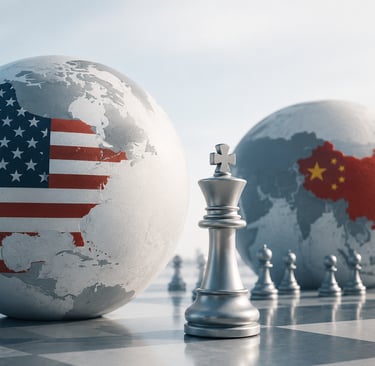
The world is bipolar, with American depth. At market exchange rates, the US economy at $31.8 trillion in 2026 runs 1.54 times the size of China's. The supposed third poles — the GCC, the EU, the emerging BRICS constellation — are significant actors, each carrying real weight, but none exercises the systemic gravity that Washington and Beijing together generate. The honest map of geoeconomic power has two centres, not five.
For lithium-producing countries, the US-China dynamic opens a structural opportunity. Competing demand from two deep, technologically sophisticated economies delivers stronger pricing power, more diversified partnerships, and access to parallel regulatory and financial frameworks. The fragmentation dividend is real — if producers build supply chains sophisticated enough to claim it.
I. The Temptation of the Epitaph
There is a particular genre of geopolitical commentary — produced in cycles, reliably, like a seasonal pathogen — that declares the American experiment finished. The patient is always on the deathbed; the obituary is always being drafted. In 2003, Iraq was going to end American hegemony. In 2008, the financial crisis was going to do it. In the mid-2010s, the rise of China was going to settle the matter. Today, the raw material is more abundant than ever: tariffs deployed by press conference, territorial ambitions toward Greenland that would have seemed eccentric in 1867 when Washington first floated the idea, an Iran confrontation of historic intensity, a relationship with the European Union calibrated somewhere between aggressive ambivalence and studied contempt. One understands the temptation.
The conclusion, however, is probably wrong — and wrong in ways that matter enormously for anyone attempting to navigate the geoeconomics of lithium, critical minerals, and the energy transition in the years ahead. Before reaching for the funeral wreath, the analyst benefits from pausing to ask a more disciplined question: what, precisely, does it mean to be a superpower? And by those criteria, how much has actually changed?
This article offers a brief for clear thinking — which is a rather different thing from defending American exceptionalism.
II. What a Superpower Actually Is
Contemporary analysis deploys the concept of superpower with remarkable looseness, usually meaning something like "large country with weapons and opinions." A more rigorous definition specifies at least five distinct dimensions: economic mass and dynamism; technological depth; military reach; cultural gravity; and institutional resilience. The United States commands positions across all five. Its nearest peer, China, has built extraordinary capacity in some of them while remaining at an earlier stage of development in others. Together — whether they intend it or not — the two constitute the architecture of world order.
The declinist narrative consistently elides this structure. Finding a dimension along which the US has weakened relative to its own past is straightforward. Finding a competitor that has displaced it across the full vector simultaneously is considerably harder. China's rise, meanwhile, demands serious acknowledgment rather than dismissal. The productive question asks what the coexistence of these two extraordinary concentrations of capacity means for the rest of the world — and specifically for the countries sitting on the minerals the energy transition requires.
III. Economic Mass: A Genuinely Bipolar World
The economics deserve close attention, because the declinist case rests most heavily on selective arithmetic — and the China-ascendancy case sometimes mirrors the same error from the opposite direction.
At market exchange rates, the IMF projects US GDP at approximately $31.8 trillion in 2026, against China's $20.7 trillion — a lead of $11.1 trillion, or 54%. The per capita dimension sharpens the picture further: China's per capita GDP runs at less than 30% of the United States', with the US ranking eighth globally on this measure and China at 77th. The United States remains one of the wealthiest countries in the world per person, not merely in aggregate.
The PPP comparison shifts considerably toward China — at purchasing power parity, China's economy reaches around $43.5 trillion against the US's $31.8 trillion. But PPP comparisons serve living-standards analysis better than strategic power analysis. The Balassa-Samuelson effect causes PPP to overstate the capacity of lower-income countries in high-tech tradables — semiconductors, advanced manufacturing, pharmaceutical IP — precisely the goods in which the US holds a deep comparative advantage.
The Balassa-Samuelson effect is the slightly irritating economic phenomenon where faster productivity growth in a country’s export industries drives up wages for everyone, including the bloke cutting hair or pouring pints (where productivity is stagnant), causing PPP to overstate the capacity of lower-income countries in high-tech tradables in this case.
The economic geography of power extends well beyond aggregate output.
China's economic achievement is extraordinary by any serious historical reckoning. An economy representing approximately 11% of US GDP in 1960 now stands at 65% — a transformation without precedent in modern economic history. China increasingly builds this on the back of electric vehicles, solar panels, and lithium-ion batteries, building globally competitive firms in telecommunications, e-commerce, fintech, and high-speed rail. The speed and deliberateness of that trajectory demands serious engagement.
The European Union presents a third case worth treating with care. At an estimated $23 trillion in nominal terms for 2026, the EU constitutes the world's second-largest economic bloc at current exchange rates. The narrative of European catastrophe relative to the United States also deserves scrutiny: Bruegel has argued convincingly that much of the apparent EU-US divergence since 2008 reflects euro-dollar exchange rate movements rather than real output differentials. The EU carries genuine structural challenges — demographic decline, energy dependency, regulatory complexity, a venture capital ecosystem capturing perhaps 5% of global VC against 52% for the US — but it anchors the world's second reserve currency and remains the world's largest trading entity. Premature obituaries have surrounded the EU before, and the EU has outlived them.
The Gulf Cooperation Council warrants an honest word, because multipolar rhetoric often casts the GCC as an emerging pole of a reordered world. Gulf states have accumulated extraordinary sovereign wealth and cultivated a diplomatic profile that would have seemed implausible a generation ago. The structural limits, however, are real: wealth without corresponding demographic depth, technological sovereignty, or institutional resilience projects influence in financial markets while leaving a country exposed to geopolitical pressure from larger actors. Financial weight is a real and consequential form of power. Systemic gravity of the kind that reshapes supply chains and anchors reserve currencies arguably requires more than sovereign wealth funds, however large.
The honest map of geoeconomic power has two centres of gravity — Washington and Beijing — with a constellation of significant but structurally more limited actors around them. This configuration differs fundamentally from Cold War bipolarity: both poles sit deeply inside the same global economy, and their competition runs through interdependence rather than separation. That distinction changes the strategic calculus for everyone, including mineral-producing states.
IV. The Civilisational Infrastructure of Technology
The declinist narrative handles one dimension of American power particularly poorly: the depth to which civilian technology originating in the United States has become the operating infrastructure of global life.
Microsoft Teams and WhatsApp run business communications across the world. Google Maps navigates it. AWS, Azure, and Google Cloud store much of the world's data — cloud computing remains an overwhelmingly American industry. GPS began as an American military project; its civilian applications now run logistics, finance, aviation, and agriculture at a scale the global economy depends on. The semiconductor design ecosystem — the EDA tools, the chip architectures, the CUDA software stack — is substantially American, even when fabrication happens in Taiwan or South Korea.
This is infrastructural power, distinct from soft power in the conventional sense: the leverage that accumulates when technological standards become the baseline assumption of global economic activity. Replacing that substrate would require a wholesale reconstruction of the technical infrastructure on which global commerce operates — a project of enormous cost, very long duration, and highly uncertain outcome.
The military picture confirms the pattern. According to SIPRI, US military spending at $954 billion in 2025 exceeded the combined expenditure of the next six countries. Defence spending is expected to cross $1 trillion in fiscal year 2026. The US outspends China — at $336 billion, itself a formidable number — by a factor of roughly three. The forward basing network, the nuclear triad, the carrier fleet, the satellite intelligence architecture: these represent eight decades of accumulated military-technological investment that a budget cycle or two cannot replicate.
V. Cultural Gravity and the Contested Experiment
Power carries a cultural dimension, and here the picture is genuinely more complex — and more interesting — than in the economic or military registers.
American cultural exports dominate global entertainment at a scale no other national culture approaches. Hollywood still organises global popular culture, despite persistent reports of creative exhaustion. Netflix and Disney+ set genre conventions and narrative expectations for audiences from Seoul to São Paulo. American music — from hip-hop to country — occupies a position of global ubiquity that no other national tradition matches. American universities attract the world's most talented students; the alumni networks they produce sustain influence that outlasts any administration's diplomatic preferences.
The current administration has damaged the institutional infrastructure of American soft power in ways that deserve acknowledgement. Cuts to USAID and the United States Agency for Global Media — the parent of Voice of America and Radio Free Europe — accelerated a decline in state-sponsored cultural diplomacy already underway. Those losses are real. The important analytical distinction runs between damage to the institutional instruments of soft power and damage to the structural gravitational field of American culture — the latter constituted by millions of individual choices about what people watch, what language they learn, where they want their children to study, what kind of political system they find worth emulating. Executive action can cut the former. The latter runs considerably deeper.
The United States is also, at this historical moment, conducting an argument — about its institutions, its democratic commitments, its constitutional settlement — that looks externally like dysfunction but operates in important respects as evidence of a working experiment. The judiciary pushes back, at least sometimes, against executive overreach. The press maintains coverage of government actions despite official hostility. Universities assert independence, as they see fit. States exercise distinct policy prerogatives. These are signs of a contested experiment, which is precisely what self-governing systems look like from the inside. The British constitutional settlement emerged from the Civil War, the Glorious Revolution, and the Reform Acts, none of which looked like foundations of stable governance at the time. Contestation and resilience are, arguably and in important respects, the same process.
VI. The Peer Relationship — and Why It May Serve Everyone
China's standing as the first genuine peer the United States has faced in the modern era carries implications that the competitive narrative typically misses.
China's achievements in the lithium supply chain illustrate what deliberate, long-horizon industrial policy produces. For 19 out of 20 important strategic minerals, China leads as the world's primary refiner, with an average market share of 70%. Chinese companies are expected to manage approximately 81% of global lithium refining activities by 2027, having identified — earlier than any Western competitor — that the value in the supply chain concentrates at the conversion step, not the mine. That was a genuine act of strategic intelligence, pursued with patience and capital concentration over fifteen years, and it has produced a position the world must accommodate.
Peer relationships impose disciplines that hegemonic relationships do not — on both parties.
China's rise has produced, whatever the diplomatic turbulence, a genuine strategic awakening in the United States on critical minerals. The 34 battery gigafactories now planned or under construction, the $14.8 billion in EXIM Letters of Interest, the February 2026 Critical Minerals Ministerial drawing 54 countries and eleven new bilateral frameworks, the invocation of the Defense Production Act to accelerate domestic mineral permitting — a world of uncontested American dominance produces none of this. Competition, in this case, has functioned as therapy.
For China, a peer-level United States performs an analogous function. Facing an economy that captures 64% of global venture capital value and hosts 22 of the world's most competitive innovation clusters, China cannot afford complacency in its own innovation ecosystem. Competition — even between state-directed and market-directed economies — generates dynamism in ways that monopoly suppresses.
The deterrence argument extends further. A bipolar world with two roughly matched powers has historically tended toward systemic stability, whatever the diplomatic temperature at the surface. The logic of mutual assured economic destruction operates in an interdependent global economy much as its nuclear cousin operated during the Cold War: it raises the cost of outright rupture to levels that rational actors are reluctant to bear.
Chinese holdings of US Treasuries, American corporate exposure to Chinese manufacturing and consumer markets, the lithium refinery that makes the battery that goes into the car that serves the US consumer: these sit embedded in the supply chain as structural deterrents.
The deterrence runs symmetrically. It constrains China's capacity to weaponise mineral supply chain leverage without absorbing significant economic costs. It constrains the US's capacity to pursue the kind of unilateral foreign policy adventurism that has periodically destabilised regions — the cost calculation in a genuinely bipolar economy differs from that in a unipolar one. A peer, in this sense, functions simultaneously as competitor and corrective.
VII. The Lithium Equation
The geoeconomics of lithium illuminate the state of American power from an instructive angle.
The United States arrived late — badly late — to recognise the strategic significance of the midstream refinery stage. US lithium production in 2024 reached approximately 4,000 tonnes, less than 1% of world production. Projected domestic production by 2035 of around 28,000 metric tonnes falls well short of a potential demand exceeding 100,000 metric tonnes. The gap is real, and executive orders alone will not close it.
American capital and institutional capacity are now moving, with the speed characteristic of systems that recognise their own lateness. The US venture capital market captured 64% of global deal value in 2025. Thacker Pass in Nevada is scheduled to deliver approximately 40,000 tonnes annually in its first phase, beginning in 2027 — a tenfold increase over current US production from a single project. Direct Lithium Extraction technology, pioneered substantially in American research institutions and now attracting capital from ExxonMobil, Chevron, and Equinor in the Smackover Formation, represents the technology frontier with the potential to materially alter extraction economics across the next decade.
The financial architecture of the global lithium economy remains deeply American. The dollar dominates foreign exchange transactions at 88% and export invoicing at 54%. Lithium contracts, wherever the ore is mined or the refinery located, price overwhelmingly in dollars. Chinese processing dominance at the midstream exists within a financial superstructure — hedging, financing, insurance, price discovery — that runs through dollar-denominated institutions.
VIII. What This Means for Lithium-Producing Countries
For any mineral-producing country navigating the geoeconomics of the next decade, the bipolar structure of the world economy functions primarily as an opportunity structure — if approached with the sophistication it demands.
A unipolar world gives one buyer the power to set terms and producers the obligation to accept them. A bipolar world, where two technologically sophisticated, capital-rich, and strategically motivated economies compete for supply chain access, delivers pricing power, partnership optionality, and the capacity to extract value from the regulatory, financial, and technological frameworks that both poles bring to the table — not merely from the rock in the ground.
American capital markets offer financing structures, patent protections, and investment frameworks that are mature, liquid, and constitutionally insulated from the most volatile political impulses. American technology in DLE, battery management systems, and downstream manufacturing represents an input to supply chain development that producers elsewhere cannot readily replicate.
The EU Battery Passport and equivalent American certification requirements are shaping global product standards; producers who build to those standards access the largest consumer markets in the world.
China's contribution to this opportunity structure carries equal weight. Chinese processing technology, midstream infrastructure, and long-term off-take financing have enabled mineral development in markets where Western capital arrived slowly or demanded risk premiums that early-stage projects could not sustain. The Chinese model of state-backed investment with long time horizons has created infrastructure that purely private-sector Western actors would not have built on those timelines. Producers who access both pools of capital, both sets of technology, and both regulatory frameworks — without surrendering strategic autonomy to either — extract value that a simpler, more aligned world would never have permitted.
The capacity to say, credibly, "we have other options" constitutes the most valuable strategic asset a mineral-producing state can hold. Building it requires institutional quality — transparent licensing, enforceable contracts, coherent regulatory frameworks — because both the US and China direct their most sophisticated capital toward partners who offer predictability. It also requires a supply chain conception that extends beyond the mine to processing, technology transfer, financial architecture, and the human capital investment that the most advanced lithium-producing economies are only beginning to make.
IX. The Weight of What Already Exists
Asking whether American decline is exaggerated produces a partial yes. The US has lost relative ground in global output share, in state-sponsored soft power infrastructure, and in the credibility of its multilateral commitments. Some of those losses are self-inflicted, and some will prove difficult to reverse.
But the more searching question is not decline-or-not. Power is a multidimensional state, distributed unevenly across domains, capable of strengthening on some axes while weakening on others. The world has moved toward a genuinely bipolar architecture, in which two extraordinary concentrations of economic, technological, and military capacity coexist within — and are in important ways held together by — the same global trading and financial system.
Before validating the declinist narrative, however, one further set of calculations deserves serious weight: the physics of institutional inertia.
World orders do not change the way governments change. They change the way geological formations change — under sustained pressure, over long periods, with high path dependency and enormous friction. The analytical error in most declinist commentary is treating power as a stock that can be rapidly drawn down, when it functions more like embedded infrastructure: slow to build, slow to decay, and deeply resistant to substitution even after it has technically been surpassed in some dimension.
Path dependency runs through every actor in this system. Investors price lithium contracts in dollars because they have always priced them in dollars, because their risk models use dollar benchmarks, because their counterparties expect dollars, because the clearinghouses settle in dollars. Changing that requires every actor in the chain to simultaneously update systems, models, legal documentation, and counterparty expectations — a coordination problem of enormous scale that no political declaration resolves overnight. The same logic applies to the routing of global internet traffic through American backbone infrastructure, to the use of US-origin software in mineral exploration and mine planning, to the reliance on American satellite positioning systems in remote extraction sites. Each of these is a separate path-dependency lock, and the locks reinforce each other.
Institutional memory compounds the inertia. Markets, governments, and financial institutions act on what they already know how to do. Mining companies raise capital on exchanges with which their lawyers and bankers are familiar. Development finance institutions deploy capital through frameworks their boards approved a decade ago. This is a sort of muscle memory… at a civilisational scale. Disrupting it requires a wholesale relearning across thousands of institutions simultaneously. That relearning is possible — it happens, over decades — but the timeline rarely matches the urgency that declinist commentary implies.
The question of which actors carry the appetite for risk that genuine disruption requires is equally important. Shifting global supply chains, reorienting financial architecture, building alternative technological standards: these demand a willingness to absorb transition costs and carry uncertainty over extended periods. The United States, for all its current turbulence, has a private sector historically accustomed to exactly this kind of risk. The venture capital ecosystem, the entrepreneurial culture, the institutional framework for creative destruction — these are real assets in a competition that will ultimately reward those willing to fund uncertain bets on new extraction technologies, new processing methods, and new supply chain architectures.
China has demonstrated comparable willingness through state direction. The European Union, whatever its considerable analytical and regulatory sophistication, has found this kind of risk appetite harder to generate at the institutional level and at the speed the transition demands.
For lithium-producing countries, these inertial forces actively shape which partnerships carry the deepest technical knowledge, the most durable financing, and the most transferable institutional capacity. A country building a lithium value chain in 2026 benefits from understanding that the incumbent frameworks — American capital markets, dollar pricing, US-origin extraction technology, Western regulatory standards — carry inertial advantages that competitors are still working to match. That does not mean the incumbent frameworks are permanent. It means that the cost of departing from them, and the timeline for doing so credibly, deserve honest calculation before strategic decisions are made.
The world is genuinely reorganising. That reorganisation is real, consequential, and underway. And it is moving at the speed that deep systems move — which is considerably slower than the commentary suggests, and considerably faster than the incumbents would prefer.
The game has not ended. The inertia of everything already built means that, for most of the actors who matter to the lithium transition — producers, consumers, investors, technologists — it has barely begun.
George Katito is the CEO/ Founder of Geostratagem