Imagining Rural Futures in the Lithium Age: (African) Villages and the Shape of Cities
A look into how critical minerals can be made to serve rural development.
HUMAN IMPACTEDUCATION
George Katito, PhD
3/3/202611 min read


In Brief
Urban bias in policy has long channelled infrastructure and talent into capitals and large cities, leaving rural areas and secondary towns as extraction zones rather than development spaces; lithium risks repeating this pattern unless this trend is consciously reversed.
Distinguishing consumption cities from production cities clarifies why many African urban centres have grown without structural transformation; lithium offers a chance to build productive secondary cities linked to rural economies instead of hollow service hubs.
A serious rural development strategy in the battery age must integrate lithium districts with nearby secondary cities, treating them as productive nodes in regional systems — sites of processing, skills, innovation and firm formation, and not just shopping malls and civil-service housing.
1. Lithium, Rural Districts and the Old Urban Bias
Lithium is flowing out of rural African landscapes into global supply chains, but policy thinking is still dominated by the gravitational pull of big cities. Classic urban-bias theory — first formalised by Michael Lipton in his landmark 1977 work Why Poor People Stay Poor — argued that post-colonial states systematically favoured urban consumers and elites through price controls, infrastructure and public employment, at the expense of rural producers. Lipton's thesis, which has since been cited more than 4,000 times in the scholarly literature, characterised the conflict as a spatial "class struggle" between countryside and city, one that cities repeatedly won.
The consequences of this bias have been material and measurable. Public investment allocation for infrastructure — roads, rail, power — has historically favoured major towns and cities, while rural areas received little equivalent investment, leaving them isolated from markets and services. Robert Chambers (1983) extended Lipton's critique to point out that even the design of rural solutions was compromised: most of the people proposing remedies to rural poverty resided in urban areas and lacked a full understanding of rural realities. In the old African context, Bates (1981) showed how these distortions operated through agricultural pricing, exchange-rate policy, and parastatal marketing boards that effectively taxed farmers to subsidise urban consumers.
Lithium slots easily into this old script. Mines are sunk into rural districts; ore or concentrate leaves by road or rail; real fiscal and political returns are booked in the capital. Local communities are expected to be satisfied with a handful of jobs and a clinic.
The DRC's Manono project — believed to hold one of Africa's largest lithium deposits — is an instructive case. Despite investment activity stretching back to 2017, the joint-venture company paid less than US$260,000 to the DRC treasury across the entire 2021–22 reporting period, while ownership disputes mired the project in legal proceedings and royalty flows remained negligible.
If we leave the spatial logic of lithium extraction untouched, it simply funds the next round of capital-city expansion — flyovers, gated estates, data centres — while rural economies remain thinly capitalised. A rural-centric lithium strategy deliberately refuses that equation.
2. Consumption Cities, Production Cities — and Why It Matters
Recent work on African urbanisation has drawn a sharp distinction between consumption cities and production cities (Gollin, Jedwab and Vollrath, 2016).
The empirical basis for this distinction is striking: Across a sample of 116 developing countries observed over the period 1960–2010, resource-exporting nations showed no statistically significant association between urbanisation rates and the share of manufacturing and services in GDP. By contrast, non-resource-exporting countries displayed a strong, positive relationship — the historically expected link between industrialisation and urbanisation.
Consumption cities are those where urban growth is driven primarily by public spending, rents, services and imported goods. Their economies revolve around administration, retail, real estate and low-productivity services; they host vibrant elites, malls and restaurant districts, but relatively little tradable industry or high-value production.
The economic mechanism is Dutch Disease: resource revenues appreciate the real exchange rate, pulling workers into non-tradable sectors and away from manufacturing, so that cities grow into consumption hubs dominated by trade, transport and government services rather than production.
Production cities, by contrast, are anchored in activities that produce tradable goods or high-productivity services — manufacturing, agro-processing, logistics, export-oriented services, knowledge industries. These cities are more tightly linked to domestic resource bases and global markets, and they tend to contribute more to structural transformation.
Many African capitals and large cities, despite their sprawl, lean heavily towards the consumption end of this spectrum. They import food, fuel and manufactured goods; they spend mineral revenues on salaries and consumption; and their links to domestic production systems are often weak. Sub-Saharan Africa's 143 largest cities together generate around US$500 billion in GDP — roughly 50 percent of the region's total — yet this aggregate conceals a profound composition problem: urbanisation is absorbing hundreds of millions of people without generating the industrial employment that historically powered structural transformation elsewhere.
Lithium, if treated as just another rent stream, will feed consumption cities — more imports, more construction, more consumption — without altering this pattern. Treated as a lever for production cities, it can finance a very different geography.
3. Putting Rurality and Secondary Cities at the Centre
Taking rural development seriously in a battery age means treating rural districts and nearby secondary cities as co-producers of national prosperity, not as staging posts on the way to the capital.
The rural district brings land, water, labour, ecological services and social capital. The secondary city — often the regional centre nearest the lithium deposits — brings a concentration of firms, training institutions, infrastructure and administrative capacity. Together, they can form a regional production system: lithium extraction and processing, agro-processing, equipment repair, logistics, engineering services, digital services, education and research.
Africa is urbanising rapidly: the number of cities on the continent has more than doubled since 1990, from approximately 3,300 to 7,600, and cumulative urban population has grown by 500 million people. A further 560 million are projected to move into sub-Saharan African cities by 2040. The question is what form this urbanisation will take. Channelling even a fraction of the coming lithium wealth into productive secondary cities rather than primate capitals could reconfigure the quality of this trajectory.
4. Lithium, Rural Futures, and the Anatomy of a Productive Secondary City
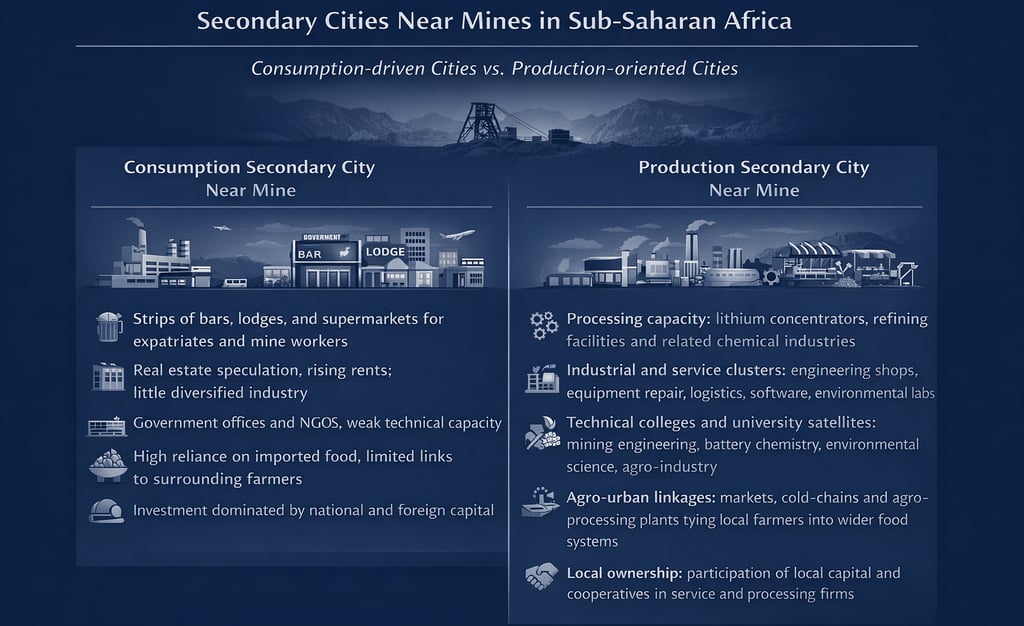
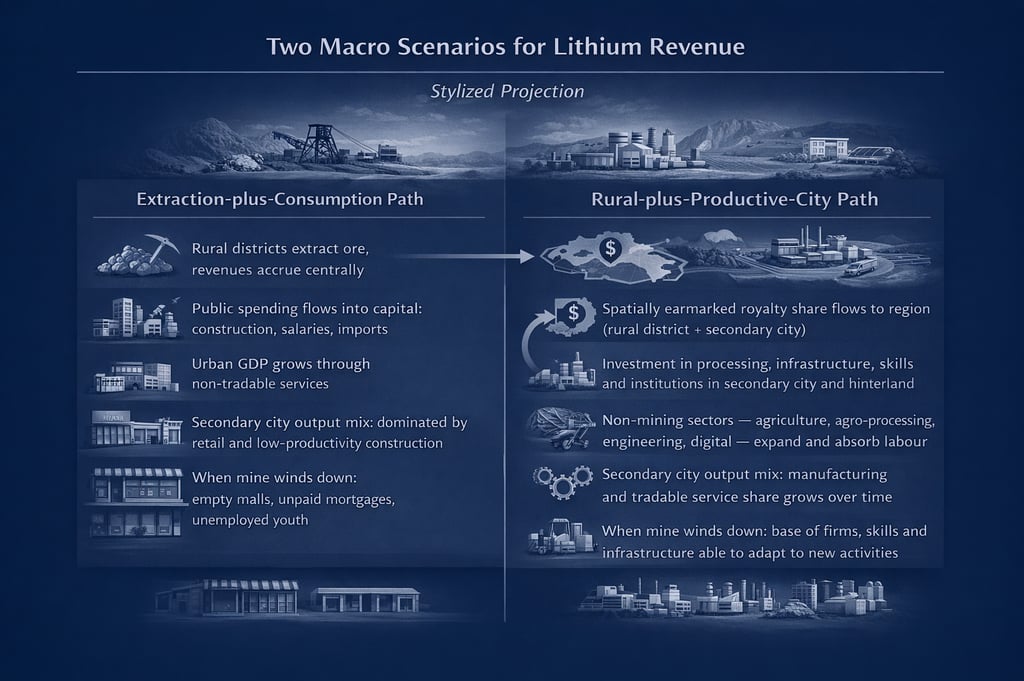
What distinguishes a productive secondary city from a hollow, consumption city in the context of lithium?
The contrast can be stated concisely:
The same number of people might live in both types of city; the difference lies entirely in what they do all day and how they connect to surrounding rural areas and global value chains. Zimbabwe's trajectory illustrates both the potential and the pitfalls. Chinese companies — Sinomine Resource Group (US$180 million acquisition of Bikita Minerals in 2022) and Zhejiang Huayou Cobalt (US$422 million for the Arcadia Lithium Project in the same year) — have dominated the sector, historically exporting raw ore to China with little processing in-country. Zimbabwe responded in December 2022 with its first ban on raw lithium exports and incentives for local processing, including a US$300 million processing plant opened in 2023 — a direct attempt to shift from consumption-city to production-city dynamics. Whether this effort succeeds will depend critically on which cities and districts capture the investment.
5. Value-Chain Mathematics
Before turning to the microeconomics of household and firm behaviour, it is worth quantifying what is at stake in the spatial contest over value addition.
African lithium production costs currently range from approximately US$250 to US$650 per tonne of spodumene concentrate, remaining competitive against the global benchmark of roughly US$800 per tonne in Australia. Africa produced 124,230 tonnes of lithium carbonate equivalent (LCE) in 2024, primarily from Zimbabwe, with Mali, Namibia, South Africa and Ghana ramping up output. Output from Zimbabwe and Namibia alone tripled between 2021 and 2025.
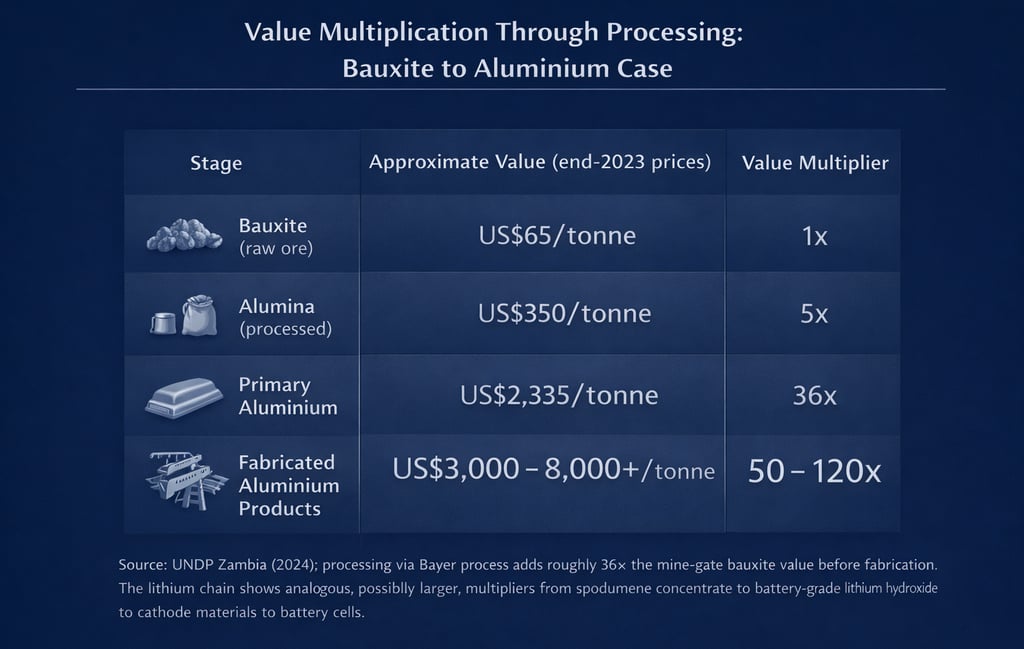
Yet the value multiplication that occurs as raw ore moves along the battery supply chain is dramatic. A simple illustration using the bauxite-aluminium analogy — a well-documented and analogous case — shows the scale of what is typically forgone:
For lithium, commodity traders estimate that Africa's total production will exceed 497,000 tonnes annually by 2030, up from around 40,000 tonnes in recent years — a twelvefold increase. If that production leaves the continent as spodumene concentrate, Africa captures the 1× value. If it is processed to lithium carbonate or hydroxide within the producing region, the capture increases substantially. If secondary city clusters also host cathode precursor manufacture, the regional economy captures value at 10× to 30× the mine-gate price. The choice of processing location is, mathematically, a decision about how much wealth stays in the rural region and how much departs.
China currently refines approximately 59% of the world's lithium and 40% of its copper, concentrating the value-addition premium in a single geography. The DRC and Zambia's emerging bilateral collaboration on battery precursors, linked to the Lobito Corridor connecting landlocked copper and cobalt country to Angola's Atlantic port, is a nascent effort to shift this arithmetic — and to anchor the multiplication within regional secondary cities rather than export it to East Asia.
6. Microeconomics of the Rural–Secondary City System
At the micro level, think of households and firms optimising their finances under constraints that are shaped by the spatial distribution of opportunity.
For a rural household, the decision set includes: stay in the village, commute to the mine, migrate to the secondary city, or bypass it entirely and head to the capital. Under urban-bias and a consumption-city pattern, the secondary city offers mainly low-wage services and rising living costs. The rational move for ambitious youth is frequently to skip it altogether. This is not merely a theoretical prediction: urbanisation data confirm that in resource-exporting African countries, cities grow primarily through the income effect of resource revenues, drawing workers disproportionately into non-tradable service employment rather than manufacturing. The result is that secondary cities near mines often exhibit the same structural deficiency as national capitals — only smaller.
In a productive city–rural system, the opportunity set is transformed:
Technical and vocational colleges in the secondary city offer pathways into skilled mine work, engineering, environmental monitoring, digital services and agro-industry.
SMEs in the city source inputs from rural producers — farmers, craftspeople, small workshops — creating demand for rural skills and products.
Commuting is viable because transport infrastructure is designed for worker mobility, not just ore haulage.
From a firm's perspective, a productive secondary city offers networks of suppliers, skilled labour, services and institutions; it becomes rational to locate there rather than in the capital. In basic microeconomic terms, good spatial policy shifts the relative prices and constraints so that it is privately optimal for both households and firms to participate in a regional production system anchored in rural-lithium–secondary-city linkages, rather than feeding the gravity of an oversized consumption capital.
The Todaro migration model — which predicts that rural-urban migration responds to expected urban wages, discounted by the probability of finding formal employment — implies a sharper point: if secondary cities offer skilled, formal-sector employment, the expected wage calculation changes enough to redirect migration flows from the capital. The policy implication is that building productive secondary cities is not merely redistributive; it is an instrument for relieving pressure on primate cities that are already struggling with slum growth, infrastructure overload and governance strain.
7. Macro and Structural Transformation: Beyond Extraction and Malls
At the macro level, the big question is whether lithium-era growth contributes to structural transformation or simply finances another round of consumption-driven urbanisation.
The international comparison is instructive. In Asia and Latin America, urbanisation has historically been tightly linked to the growth of manufacturing and tradable services as a share of GDP. In Africa and the Middle East, the association breaks down: in countries where natural resource exports exceed approximately 10 percent of GDP, urbanisation is correlated with resource revenues rather than industrialisation, and the composition of urban employment tilts toward trade, transport and government services rather than manufacturing or exportable services.
The macro-economic logic is reinforced by the commodity-cycle argument. Resource prices are volatile. Africa's lithium output tripled between 2021 and 2025, and prices have surged sharply in 2026 — but the history of commodity cycles from copper in Zambia to oil in Angola warns against assuming this lasts. A consumption-oriented secondary city — its economy built around mine-worker spending and government transfers — faces a severe hangover when prices fall or ore grades decline. A productive secondary city, by contrast, has built a base of diversified firms, trained workers and research institutions that can pivot to new activities. This is the standard resource-curse antidote reframed spatially: the question is not just whether resource rents are saved (the Norwegian fund argument), but whether they are invested in places and institutions that survive the commodity cycle.
8. Policy Levers: From Urban Bias to Regional Systems
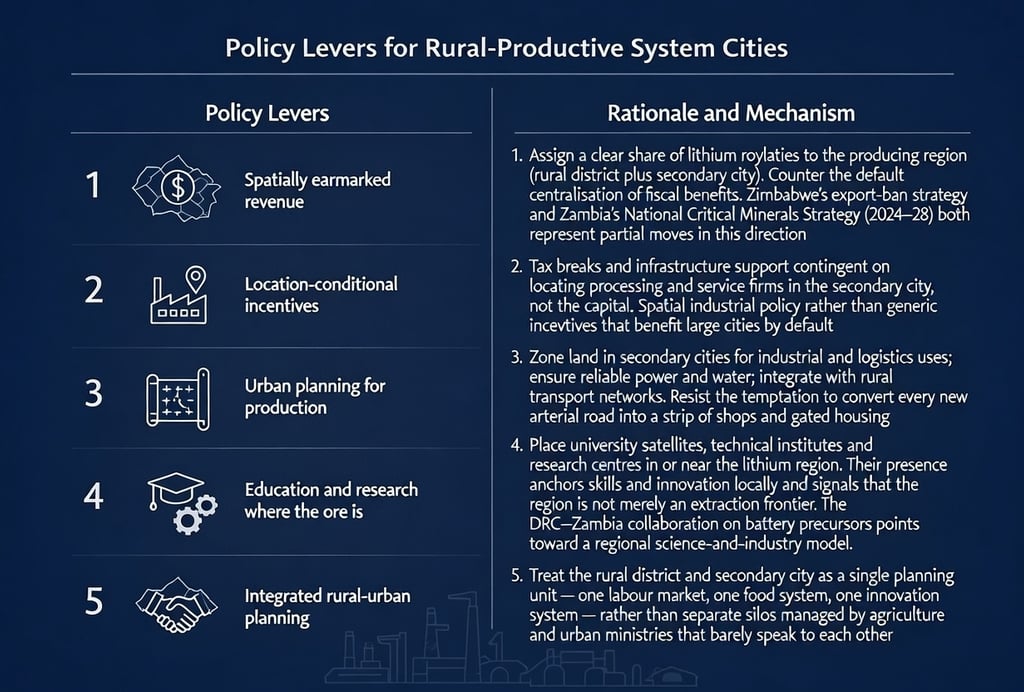
What would it take, concretely, to tilt the system away from urban bias and hollow consumption cities, and towards rural–productive-city systems? Five categories of policy lever deserve emphasis:
These levers are not untested. The Lobito Corridor — connecting Zambia and DRC to Angola's Atlantic port — demonstrates what infrastructure investment oriented around regional production systems rather than capital-city primacy can look like. The DRC–Zambia Special Economic Zone for battery and electric-vehicle production represents an early attempt at anchoring value addition in the producing region. Zimbabwe's US$450 million refinery planned for the Mapinga Industrial Park is another data point. None of these initiatives is without risk: governance failures, corruption, and the tendency for Chinese partner firms to import labour and intermediate inputs rather than sourcing locally are all documented problems. But they indicate that the productive secondary-city model is not purely theoretical — it is being contested, haltingly, in practice.
9. Rural Futures, Lithium and the Politics of Direction
Ultimately, the question is not whether African states will urbanise — they will, and they should. The question is what kind of urbanisation lithium will finance, and with what spatial and social consequences.
One path leads to more of the same: rural landscapes as extraction zones, secondary cities as convenience stores for the mine and the civil service, capitals as expanding consumption hubs. This is urban-biased lithium, and it will leave the countryside as politically marginal as ever, only dustier. The academic evidence is unambiguous: resource exporters that have urbanised without industrialising tend to have higher poverty rates and larger slum populations than their income levels would predict. The income effect of resource revenues reaches cities, but it reaches them in the form of consumption rather than productive capacity.
The other path is more demanding: it asks governments, companies and communities to choreograph lithium into a wider project of rural futures and productive secondary cities. That means saying no to some apparently 'efficient' choices for firms (like centralised processing in the capital), resisting the seductions of easy urban consumption, and building institutions in places that have long been treated as peripheries. It means insisting that the reflexive answer to the question 'where should the value be captured?' is no longer 'in the capital,' but 'in the regions that host the resources and people.'
In a battery age defined by critical minerals, supply-chain nationalism and strategic competition — with the US, EU, China, India and Gulf states all manoeuvring for access to African lithium belts — the window for African governments to impose this spatial logic is not unlimited. Leverage exists today. The decisions made now about royalty structures, processing incentives, infrastructure routing and university placement will determine whether Africa's lithium landscapes become yet another chapter in the story of urban-centred extraction, or the setting for a quieter, more distributed revolution in how we think about the countryside, the city, and the spaces in between.
Selected References and Data Sources
Gollin, D., Jedwab, R. and Vollrath, D. (2016). Urbanisation with and without Industrialisation. Journal of Economic Growth.
Lipton, M. (1977). Why Poor People Stay Poor: Urban Bias in World Development. Temple Smith/Harvard University Press.
Bates, R. (1981). Markets and States in Tropical Africa. University of California Press.
UNECA (2017). Economic Report on Africa: Urbanisation and Industrialisation for Africa's Transformation. United Nations Economic Commission for Africa.
Global Witness (2023). The Lithium Rush in Africa. globalwitness.org.
UNDP Zambia (2024). Southern Africa Must Process Its Own Critical Minerals.
Columbia University CGEP (2024). Critical Minerals to the Rescue? Zambia and Zimbabwe Implement Divergent Policies.
ISS African Futures (2025). Zimbabwe's Lithium Beneficiation Policy: A Catalyst for Vision 2030.
African Mining Online / African Energy Chamber (2026). Africa: A Central Player in the Global Energy Transition.
CSIS (2025). Urbanisation in Sub-Saharan Africa.
Meier zu Selhausen, F. (2021). Growing Cities: Urbanisation in Africa. AEH Network.
*George Katito is CEO and Founder of Geostratagem